
- Magway records most airstrikes since new military chief took command: ISP-Myanmar
- Junta warship destroys two fishing boats, seizes another off Werathani
- Junta jet fighters drop 500-pound bombs on former junta battalions in Mrauk-U
- Junta deploys fighter jets to bomb Ponnagyun
- Rathedaung villagers set up night watches amid Sittwe clashes, ARSA threat
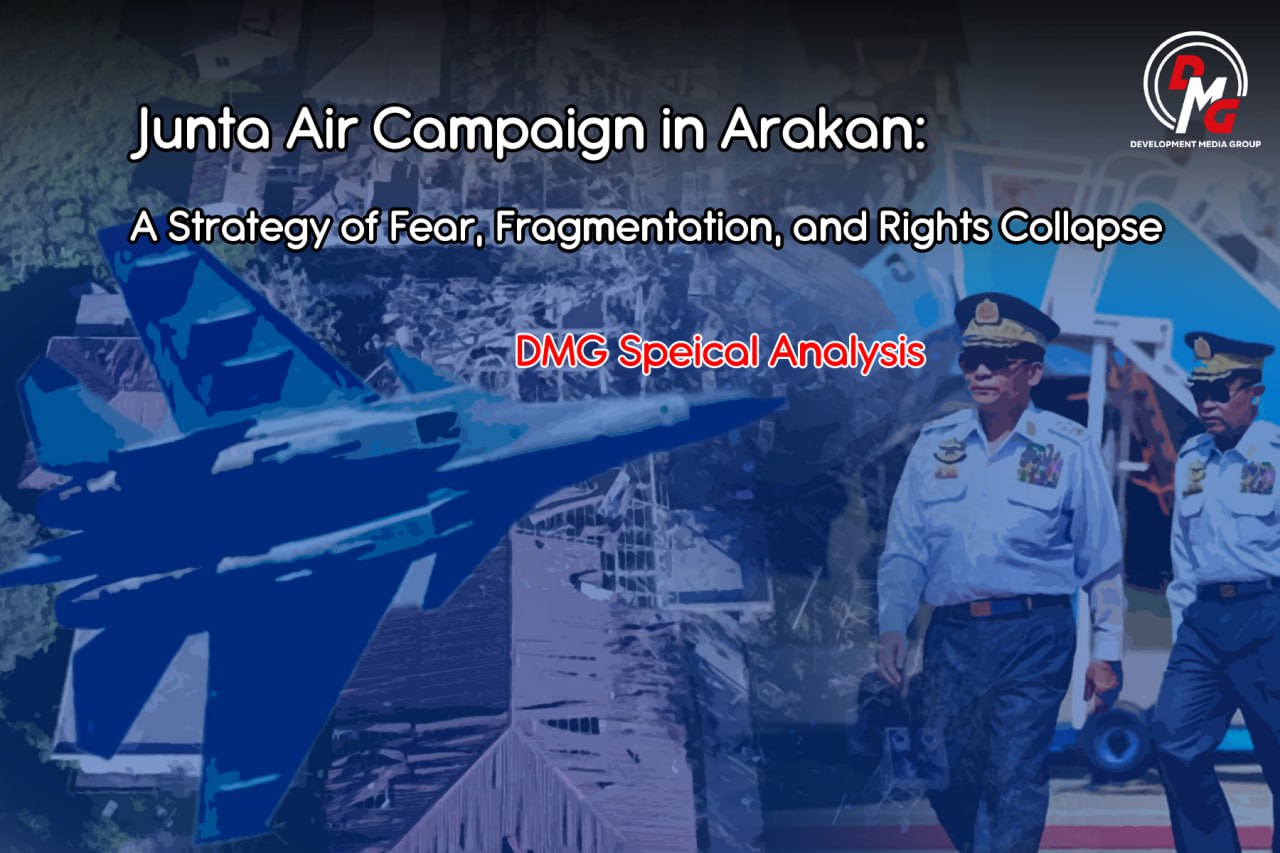
Junta Air Campaign in Arakan: A Strategy of Fear, Fragmentation, and Rights Collapse
What defines the current phase of violence is not only the rising tempo of attacks but their expanding geographic sweep. Although Myanmar’s conflict has long included aerial strikes, recent weeks reveal a new pattern:
16 Dec 2025
DMG Speical Analysis
On December 10, International Human Rights Day, while the world reaffirmed the universality of human rights, Myanmar’s military junta carried out a devastating airstrike on Mrauk-U Public Hospital. More than 30 people — patients and caretakers — were killed and over 70 injured as bombs tore apart a functioning health facility. The attack was shocking not only for its brutality but for its deliberate symbolism: an assault on the right to health on a day meant to defend human dignity.
Eyewitness accounts and monitoring data show that this was not an isolated incident. Since early December, junta air operations — involving jet fighters, Y-12 aircraft, and armed drones — have increasingly targeted civilian infrastructure and populated areas across Arakan State, including Kyaukphyu, Gwa, Rathedaung, Pauktaw, Mrauk-U, and Sittwe. Schools, monasteries, clinics, and entire villages have been struck. Reports of cluster munitions, rockets, and repeated heavy bomb drops point to a deliberate and sustained aerial campaign.
Pattern of Escalation: Beyond Battlefield Logic
What defines the current phase of violence is not only the rising tempo of attacks but their expanding geographic sweep. Although Myanmar’s conflict has long included aerial strikes, recent weeks reveal a new pattern:
1. Nighttime, multi-township aerial operations, striking deep inside civilian settlements.
2. Use of indiscriminate weapons such as cluster munitions, heavy bombs, and drones.
3. Systematic targeting of protected facilities — hospitals, schools, IDP sites — in clear violation of international humanitarian law.
Strikes on education centers have killed both students and teachers. Earlier this month in Minbya, a student and a teacher were killed. In Kyaukphyu, cluster bombs destroyed free learning centers and monasteries.
These are not military precision strikes aimed at armed adversaries. They reflect a broader strategy of collective punishment and psychological terror, where air power is used to destabilize communities, force displacement, and undermine any functioning civilian administration outside junta control.
Humanitarian Consequences: Rights in Freefall
The human impact is vast and multilayered:
Right to Life and Security: The Mrauk-U hospital bombing shattered one of the strongest humanitarian norms — the protection of medical facilities.
Right to Health: Destroyed hospitals and clinics leave tens of thousands without urgent medical care amid rising conflict-related injuries.
Right to Education: Bombed schools, displaced teachers, and soaring textbook prices have stripped countless children of education. Home-based learning cannot compensate for systemic disruption.
Freedom of Movement: Widespread displacement is accelerating, overwhelming families and local support systems.
Livelihoods: Blockades, village bombardments, and destruction of marketplaces cripple agricultural and economic activity, pushing communities closer to humanitarian collapse.
Meanwhile, humanitarian access remains severely restricted. Even globally recognized actors — WFP, ICRC, WHO — face barriers in reaching affected populations.
Political Dimensions and International Response
The escalation coincides with the junta’s preparations for a staged election, widely rejected as a legitimacy exercise rather than a political solution. Instead of dialogue or de-escalation, the regime has intensified coercive tactics — an unsustainable response for a state fractured along ethnic, political, and territorial lines.
Despite repeated international condemnations, the global response has been weak and largely symbolic. Words alone have not halted the airstrikes, lifted blockades, or protected civilians.
A meaningful international strategy would require:
Restricting aviation fuel supplies and logistics that sustain air operations.
Supporting independent documentation for future accountability processes.
Establishing cross-border humanitarian corridors that bypass junta control.
Recognizing and working with local governance structures, including community-based education and health systems.
Rejecting the junta’s manufactured political processes, which serve only to mask ongoing abuses.
Why Arakan’s Crisis Matters Globally
The escalation in Arakan illustrates a broader truth: Myanmar’s human rights crisis is neither contained nor isolated. It affects regional stability, cross-border security, displacement patterns, and the integrity of global humanitarian law.
The Mrauk-U hospital bombing — alongside coordinated strikes across multiple townships — underscores the failure of international mechanisms intended to protect civilians and restrain armed actors. Each unaddressed atrocity erodes the norms that safeguard civilian life worldwide.
Conclusion: Rights Cannot Wait
The events of December 10 serve as a stark reminder that human rights advocacy must be measured by action, not rhetoric. International Human Rights Day holds meaning only when its commitments translate into real protection, accountability, and an end to impunity.
For the people of Arakan — and Myanmar at large — the rights to life, health, education, and dignity are hanging by a thread. The world must respond not with platitudes but with coordinated pressure, inclusive humanitarian pathways, and a recognition that when rights collapse in one place, all humanity is diminished.
*Prepared by DMG Editorial/Analysis Desk, drawing on field reporting and recent incident compilations.*

Opinion
.jpg)
How Can Myanmar’s Political Crisis Be Brought to an End?
By Admin 13 Sep 2026
By Cutting Trees, We Are Killing Ourselves
By Admin 06 Sep 2026
A Modern August We Must Never Forget
By Admin 31 Aug 2026
Arakan’s Political Shifts and the Debate Over Rights and Governance
By Admin 27 Aug 2026
Securing Rights for Bangladesh's Indigenous Peoples is Indispensable
By Admin 09 Aug 2026
POLITICS

BUSINESS
Industry to manufacture finished goods from coconut starting in early 2020
By Aung Kaung Zaw 20 Nov 2019