

- Locals report bribery in ULA departmental recruitment
- Weekly Highlights from Arakan State (Jan 19-25, 2026)
- Junta uses newly-recruited conscripts as ‘human waves’ on frontlines
- Traffic rules tightened in Arakan Army controlled areas
- DMG Editorial: Bombing the Defenceless, When War Crosses Every Red Line in Arakan
Weekly Highlights from Arakan State (Jan 19-25, 2026)
This series is designed for readers and viewers seeking a concise yet comprehensive understanding of how ongoing conflict, governance shifts, and community issues continue to shape lives across Arakan.
27 Jan 2026
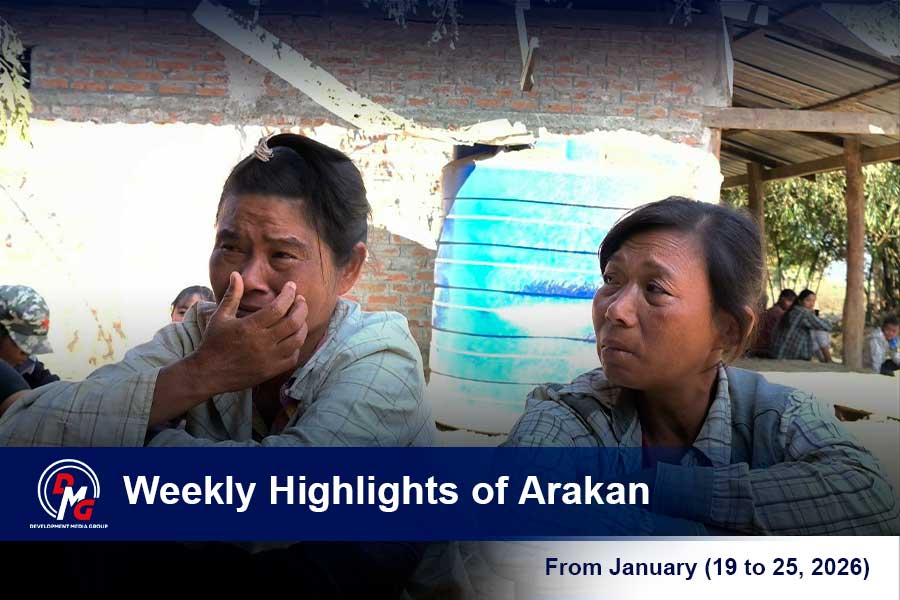
In an era when daily news from Arakan is often fragmented and fast-changing, DMG's Weekly Highlights of Arakan brings clarity, depth, and context to the stories that matter most.
Each week, we round up key political, military, social, and humanitarian developments across Arakan State - connecting the dots between events and offering analysis to help audiences see the bigger picture.
This series is designed for readers and viewers seeking a concise yet comprehensive understanding of how ongoing conflict, governance shifts, and community issues continue to shape lives across Arakan.
Junta airstrike kills 21 POWs, family members at Kyauktaw detention centre
Myanmar’s military regime carried out an airstrike on a detention centre holding prisoners of war (POWs) and their family members near Chaungtu Village in Kyauktaw Township, Arakan State, killing 21 people and injuring 30 others, according to local sources.
The attack occurred at around 7:30 pm on January 20, when a junta jet fighter dropped four bombs on the site. The explosions hit dormitories and a clinic where POWs and their families were staying, causing mass casualties.
An official at the Chaungtu detention centre told DMG that two of the bombs struck the clinic where injured detainees were receiving treatment, while the others hit the POW dormitory and a nearby family dormitory.
Daw Thazin Cho, the wife of the commander of the military’s No. 377 Artillery Battalion in Kyauktaw, said detainee families faced dire conditions as the airstrike took place at night.
Thousands of junta soldiers and their families who surrendered during the Arakan Army’s offensive to seize control of Arakan State are being held at various locations. Some detainees and family members have been released in batches by the Arakan Army.
According to DMG data, the military has bombed four detention camps in Pauktaw, Maungdaw, Mrauk-U and Kyauktaw townships between September 2024 and January 2026.
On September 8, 2024, a jet fighter attacked a POW detention camp near Shinywa Village in Pauktaw Township, killing 17 detainees and injuring 10 others. The following day, an airstrike near 4th-Mile Village in Maungdaw Township killed 60 POWs and detainees and wounded many others.
On January 18, 2025, the military bombed a camp housing POW family members in Yanchaung Village, Mrauk-U Township, killing 28 women and children and injuring another 28 people.
Two IDPs killed, five injured in junta drone attack on Kyaukphyu village school
Two internally displaced persons (IDPs) were killed and five others, including a nine-month-old infant, injured when Myanmar’s military regime carried out a drone attack on a school in Muywin Village, Kyaukphyu Township, Arakan State, at around 1:00 PM on 24 January.
The deceased have been identified as Daw Phyu Nu Ma, 81, and U Mel Daung, 56, both from Thaingchaung Village in Kyaukphyu Township.
The injured include Maung Aye Min Khaing, 9 months old, and Daw Khin Hsan Win, 34, from Saichonedwain Village; Daw Ma Mya Yin, 56, from Thaingchaung Village; Daw Ba Nu Ma, 67, from Zaichaung Village; and U Maung Kyaw, 63.
This comes two days after the military regime conducted a drone attack on Konbaunggyi Village in Kyaukphyu Township on 22 January, which left two civilians injured.
According to a DMG tally, between 20 February 2025, when the Kyaukphyu Battle began, and January 2026, the military regime has carried out artillery and aerial attacks on at least 10 villages, resulting in at least 128 casualties.
Muslim militiamen flee junta camps in Sittwe amid oppression, discrimination
Investigations have revealed that Muslim militiamen forcibly recruited into military camps in Sittwe are fleeing because they can no longer endure oppression within the Myanmar military.
Members of the Muslim community say the militiamen are escaping from junta battalions in Sittwe due to ethnic discrimination by military officers, forced labour and other abuses.
On January 16, the military regime reportedly arrested a camp commander after four Muslim militiamen from a military outpost in Ohntawgyi Village allegedly fled to the Say Thamargyi military outpost. The four escapees are being intensively searched for and have not been found to date.
On the same day, 15 Muslim militiamen reportedly fled from a military outpost near Barsa Village.
The administrator of Barsa Village is reportedly facing pressure and threats from the military regime to search for the fleeing militiamen.
Locals said the military regime is using Muslims to defend Sittwe, which is under attack by the Arakan Army, while restricting movement out of the city, negatively affecting residents’ socio-economic lives.
Children in Arakan State face rising cases of pneumonia and flu
Health professionals and parents say children in Arakan State, controlled by the Arakan Army, are increasingly suffering from pneumonia, phlegm, and seasonal flu this winter, a trend they attribute to climate change.
Parents have reported a rise in pediatric patients at township hospitals across the state this month.
Health experts note that during winter, respiratory diseases such as pneumonia, asthma, and colds are common among children, especially those under two years old.
To prevent these illnesses, they recommend that children receive nutritious foods in addition to breast milk and complementary foods after six months of age.
A nurse at the Department of Public Health under the United League of Arakan said, “During winter, children are more prone to illness. Infants under one year should be fed frequently to strengthen their immune system. Children with asthma should also have their daily surroundings kept clean.”
The health community stresses that children should receive routine influenza vaccinations during the winter season.
Since the start of fighting over control of Arakan State, Myanmar’s military regime has imposed road blockades, causing shortages of medicines, skyrocketing prices, and restricted access to healthcare.
Locals face crises including a lack of hospitals and clinics, insufficient health workers, and preventable deaths due to medicine shortages, high costs, and transportation difficulties.
The military regime has restricted land and sea movement of goods into Arakan State since November 2023, resulting in medicine shortages and limited access to vaccinations.
The Department of Public Health has begun vaccinating children under the age of two, but health professionals say the need for healthcare remains urgent, as hospitals and clinics have been displaced by military airstrikes.
Junta navy activities halt fishing in Thandwe
Fishing activities in Thandwe Township have come to a halt due to Myanmar Navy operations in coastal waters and the arrest of local residents, according to locals.
As a result, fishermen are facing growing difficulties in earning a livelihood.
On January 18, six locals and four fishing boats from Jeittaw Ward in Ngapali Town were arrested at sea by the Myanmar Navy.
Among those detained, Ko Moe Kyaw Aung, Ko Maung Soe Kyaw, Ko Aung Min Lwin, and Ko La Pyae remain in military custody. Ko Aung Kyaw Htun is missing, while Ko Kyaw Zan Phyo has been released.
Although Thandwe Township is currently under the control of the Arakan Army (AA), residents say Myanmar Navy warships continue to operate in nearby waters, disrupting livelihoods.
Fishing in Thandwe’s coastal waters was suspended in November 2023 due to fighting in Arakan State. After the Arakan Army took control of the area, a small number of locals resumed near-shore fishing to survive. However, recent arrests by the military regime have again brought all fishing activities to a stop, residents said.
The Arakan Army seized control of Thandwe on September 5, 2024. Since then, Myanmar Navy vessels have frequently patrolled the area and fired artillery shells, resulting in civilian casualties.
Residents say the military regime continues to harass and destroy areas controlled by the Arakan Army through air and naval attacks.
According to a DMG tally, at least 140 civilians have been killed by airstrikes, artillery shelling, and small arms fire since fighting broke out in Thandwe Township in April 2024.
Mitragyna speciosa leaves fetch K200,000 per viss in Arakan State
The price of Mitragyna speciosa leaves has reportedly risen to as high as K200,000 per viss in Arakan Army-controlled townships in Arakan State, amid growing use of the leaves as a narcotic.
Local residents say people of all ages in Arakan State are using Mitragyna speciosa leaves to relieve stress.
Mitragyna speciosa plants are commonly grown in townships including Ponnagyun, Kyauktaw, and Buthidaung, and are widely used in Kyauktaw and Ponnagyun townships.
The leaves are eaten raw, while extracted liquid from the leaves is boiled and mixed with cough syrup, Coca-Cola, milk or coffee, and sold as a drink.
Restaurants and bars in Arakan Army-controlled areas are reportedly selling the extracted liquid in a manner similar to alcohol, resulting in large numbers of people consuming it. Locals also say the extracted liquid is used by cooking groups preparing donated meals.
Troops from the Department of Law Enforcement and Public Security (DLEPS), working with village administrators, are reportedly clearing Mitragyna speciosa plants.
Mitragyna speciosa leaves are classified as a narcotic and are banned in Myanmar, but are legally sold and used in neighbouring Thailand.
According to members of the health community, long-term use of Mitragyna speciosa leaves as a drug can lead to physical and psychological changes, liver and kidney damage, memory loss, depression, and cancer.
Young people in Arakan State say they are losing hope for the future due to limited access to jobs and education, and are turning to drugs as an outlet. In recent years, the use of marijuana among young people in Arakan State has also reportedly increased.

Top News
Weekly Highlights from Arakan State (Jan 19-25, 2026)
By Admin 27 Jan 2026
Locals report bribery in ULA departmental recruitment
By Admin 26 Jan 2026
Traffic rules tightened in Arakan Army controlled areas
By Admin 26 Jan 2026
Junta uses newly-recruited conscripts as ‘human waves’ on frontlines
By Admin 24 Jan 2026
Arakan Army bans illegal two-digit and three-digit lottery gambling in Arakan State
By Admin 24 Jan 2026

.jpg)