

- Junta attacks kill 15 women in Arakan, 49 nationwide in October: BWU
- Extreme heat, water shortages damage paddy fields across Arakan
- Junta airstrikes kill 145 civilians, injure 316 in October: MDSI
- Myanmar's garment industry faces deepening crisis: ISP report
- Up to 600,000 displaced people in Arakan face worsening humanitarian crisis: CAS report
Centralization in the Name of the Union : Military Domination, Unequal Power-Sharing, and the Roots of Myanmar’s Unfinished Revolutions
Why have armed conflicts and political struggles persisted in Myanmar for decades without a lasting resolution?
11 Nov 2026
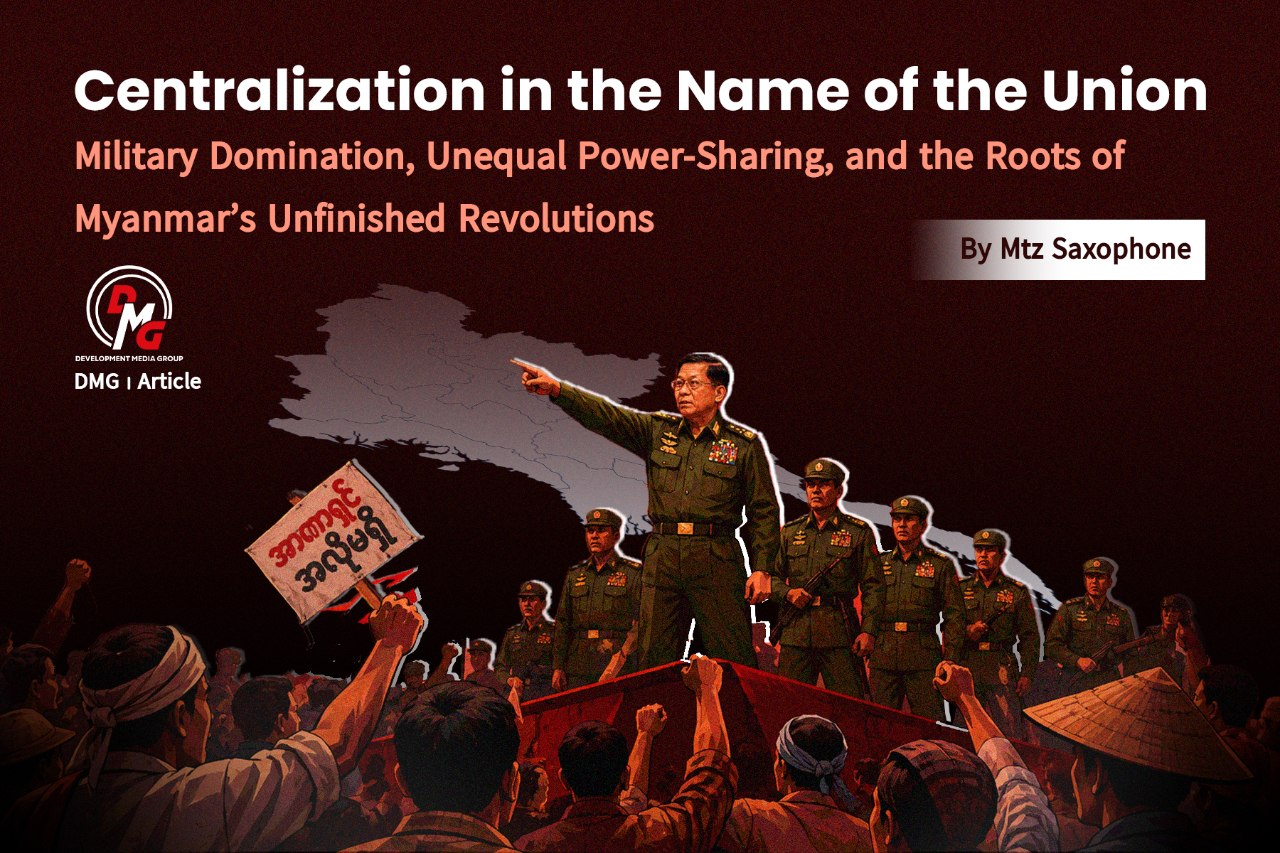
By Mtz Saxophone
Why have armed conflicts and political struggles persisted in Myanmar for decades without a lasting resolution?
The answer lies not simply in ethnic divisions or armed resistance, but in deeper questions of political power, territorial control, natural resources, and economic inequality. Who makes decisions? Who controls the country's wealth? And who benefits from the political and economic system?
Myanmar presents a striking contradiction. In a country where many people value the Buddhist teachings of compassion and loving-kindness, generations have endured warfare, authoritarian rule, and repression. Despite its abundant natural gas, gemstones, minerals, and forests, the country has struggled to turn its natural wealth into broad improvements in people's lives.
Its strategic location between China and India offers significant opportunities for trade, investment, and regional connectivity. Yet when local communities are excluded from the benefits, these opportunities can reinforce competition among powerful political and economic actors rather than promote inclusive development.
Myanmar's prolonged conflicts cannot be explained by blaming any particular ethnic community. Instead, their underlying causes must be examined through the interconnected forces of “Bamar-centric state-building, military domination, centralized political authority, and the concentration of economic resources in the hands of powerful elites”.
The Panglong Promise and the Failure of Genuine Power-Sharing
The 1947 Panglong Agreement remains a defining milestone in Myanmar's struggle to establish a political union. Negotiated between General Aung San and representatives of the Shan, Kachin, and Chin communities, it recognized, in principle, autonomy in internal administration for the Frontier Areas concerned.
However, Panglong was neither a comprehensive federal constitution nor an agreement representing every ethnic community in the country.
Following independence in 1948, the distribution of authority between the central government and the constituent states remained a major source of political disagreement. Although the 1947 Constitution recognized certain rights and administrative arrangements for some ethnic regions, substantial powers remained concentrated at the center.
The fundamental question has therefore remained unresolved: How much authority have Myanmar's constituent states and regions actually possessed to determine their political, economic, and administrative futures?
A union cannot be judged by its name alone. Its legitimacy depends on whether its members enjoy meaningful political equality, autonomy, and a fair share of decision-making power.
Military Domination and the Cycle of Centralization
After independence, influential military leaders increasingly regarded demands for federalism and ethnic autonomy as threats to national unity.
The 1962 coup led by General Ne Win marked a decisive turning point, entrenching military dominance over Myanmar's political system. In the decades that followed, military responses frequently took precedence over political dialogue and negotiated solutions.
This approach helped create a destructive cycle.
The refusal to share power deepened political grievances. Those grievances contributed to prolonged armed resistance, while continuing conflicts provided the military with a justification for retaining political authority in the name of national security and territorial unity.
This cycle is central to understanding Myanmar's political instability, although individual conflicts have also been shaped by distinct historical circumstances, ideological differences, and competing local interests.
The central question remains whether concentrating power in the name of preserving the Union has actually strengthened national unity or instead contributed to the divisions it was supposed to prevent.
Bamar-Centric State-Building and the Political Use of Religion
The Bamar language, culture, and Buddhist traditions are important elements of Myanmar's history and national life. Problems arise, however, when these are promoted as a single national identity to which all communities are expected to conform.
Such an approach risks marginalizing the languages, cultural identities, and political aspirations of other ethnic communities.
Criticism of Bamar-centric state-building should not be confused with criticism of the Bamar population as a whole. The issue is not the identity of an ethnic majority, but the use of that identity to legitimize centralized political authority.
A similar distinction must be made between Buddhist faith and the political exploitation of religion.
Buddhist teachings emphasize compassion, loving-kindness, and the avoidance of harm. Yet when religion is used to justify political domination, ethnic discrimination, or restrictions on religious minorities, these principles risk being undermined.
The rights of citizens should not depend on their ethnicity, language, or religious beliefs. A genuinely inclusive political union must protect the identities and freedoms of all communities equally.
Natural Resources and the Illusion of Power-Sharing
Myanmar's natural-resource problem is not simply a question of how much wealth the country possesses. It is fundamentally about who controls extraction, who receives the revenues, and how much benefit reaches the communities living in resource-rich areas.
Historically, the concentration of resource revenues and decision-making authority at the central level has reinforced demands from ethnic regions for greater autonomy and a fairer distribution of economic benefits.
Yet decentralization alone cannot guarantee justice.
The economic interests of military-linked enterprises, politically connected businesses, and some local armed organizations also require scrutiny. Transferring control from central authorities to regional powerholders will accomplish little if ordinary citizens remain excluded from decision-making.
Meaningful resource governance requires transparency, financial accountability, environmental protection, and public participation.
The same principle applies to political representation.
Appointing an ethnic leader to a ministerial position does not necessarily amount to genuine power-sharing. Without meaningful authority over budgets, land, natural resources, education, and local administration, such representation may be largely symbolic.
Ethnic political leaders must also be accountable to the communities they claim to represent. Their positions should serve public interests rather than personal or institutional gain.
Genuine power-sharing is not simply the distribution of government positions. It requires a fair distribution of decision-making authority, financial resources, and political accountability.
Why Myanmar's Revolutions Remain Unfinished
Myanmar's revolutionary movements have emerged from different historical circumstances and pursued different political objectives.
Communist-led insurgencies, ethnic struggles for self-determination, and pro-democracy movements cannot all be reduced to a single cause. Nevertheless, many have confronted recurring problems: unequal political power, the absence of credible negotiations, human rights abuses, and a lack of justice.
Following the 2021 military coup, armed resistance expanded across predominantly Bamar regions of central Myanmar, demonstrating that the country's political crisis cannot be understood solely as a confrontation between the Bamar majority and ethnic minorities.
Yet significant disagreements remain among anti-military and resistance forces over the structure of a future federal system, the distribution of political authority, and territorial administration.
These differences raise an essential question: Can movements seeking to end centralized authoritarianism establish political systems that are genuinely more inclusive and accountable?
The legitimacy of a revolutionary cause does not exempt any organization from accountability to the people.
If resistance to centralized authoritarianism results in equally unaccountable systems of local power, the outcome may be little more than a change in who exercises authority.
The success of a revolution must therefore be measured not only by military achievements, but also by its ability to protect rights, share power, and establish accountable governance.
A Genuine Union and the Path to Lasting Peace
Lasting peace in Myanmar requires more than replacing one set of rulers with another.
It demands civilian control over the military, meaningful political and fiscal power-sharing between the Union and its constituent states, and equal protection for different languages, cultures, and religious communities.
The autonomy of an ethnic majority within a particular state must also be accompanied by safeguards for minorities living within that state. Federalism cannot be considered genuinely inclusive if decentralization merely reproduces exclusion at the regional level.
Nor is federalism simply a transfer of authority from the central government to state governments. It must establish institutions through which citizens can scrutinize those who govern them, demand accountability, and exercise their rights regardless of where they live.
The state should not be treated as the property of any single ethnic community, religion, military institution, or armed organization.
The strength of a political union cannot be measured solely by whether its territorial boundaries remain intact. It must also be judged by whether the people living within those boundaries have the freedom, equality, and political authority to shape their collective future.
The enduring strength of a Union should come not from people remaining together out of fear or subordination, but from their willingness to coexist because they enjoy equal rights and the freedom to determine their own future.

Opinion

Diwali: Illuminating the Path Towards a More Inclusive Society
By Admin 09 Nov 2026
The Journey of Arakanese Language Education
By Admin 03 Nov 2026
Can the UN Restore Trust in a Fractured World?
By Admin 23 Oct 2026
Arakan Amid the Storm: From Survival to Rebuilding a People
By Admin 22 Oct 2026
Surviving Amid the Bombs: Arakan's Quiet Resistance
By Admin 19 Oct 2026
POLITICS


BUSINESS



Industry to manufacture finished goods from coconut starting in early 2020
By Aung Kaung Zaw 20 Nov 2019