
- Magway records most airstrikes since new military chief took command: ISP-Myanmar
- Junta warship destroys two fishing boats, seizes another off Werathani
- Junta jet fighters drop 500-pound bombs on former junta battalions in Mrauk-U
- Junta deploys fighter jets to bomb Ponnagyun
- Rathedaung villagers set up night watches amid Sittwe clashes, ARSA threat
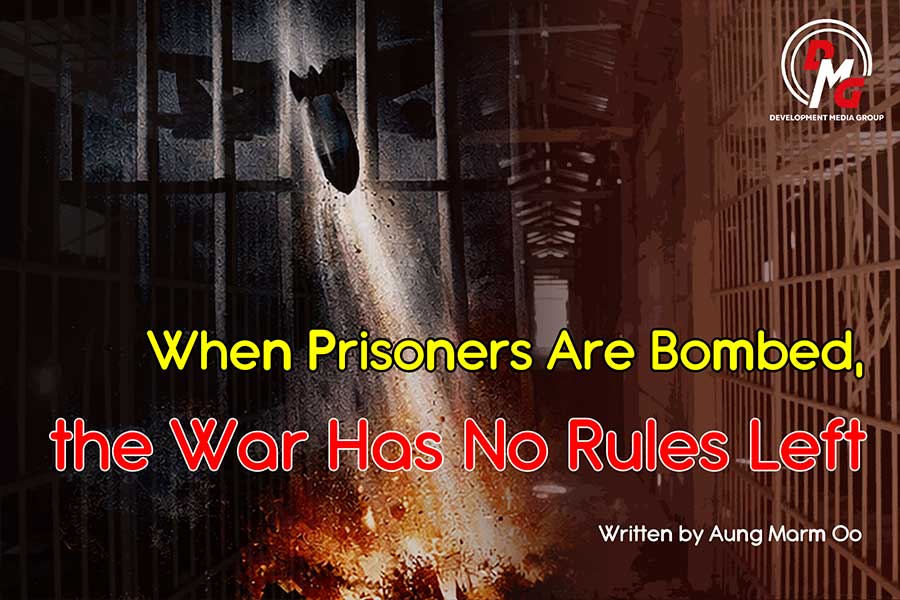
When Prisoners Are Bombed, the War Has No Rules Left
In most wars, there are lines that even amid brutality are understood not to be crossed. Prisoners of war, their families, clinics, and detention facilities are supposed to be among them. In Arakan, Myanmar’s military has erased those lines from the sky.
20 Feb 2026
Written by Aung Marm Oo
In most wars, there are lines that even amid brutality are understood not to be crossed. Prisoners of war, their families, clinics, and detention facilities are supposed to be among them. In Arakan, Myanmar’s military has erased those lines from the sky.
The January 20 airstrike on a detention centre near Chaungtu Village in Kyauktaw Township, which killed 21 prisoners of war and family members and injured dozens more, was not an aberration. It was the fourth mass-casualty airstrike on POW detention sites in Arakan since late 2024, Pauktaw, Maungdaw, Mrauk-U, and Kyauktaw. Different locations, same pattern.
This is no longer war fought for territory. It is war fought against restraint itself.
The Sky as a Weapon of Punishment
Across much of Myanmar, the military has relied on airpower as ground control has eroded from Sagaing to Chin, Karenni, and northern Shan. But Arakan now stands apart in both scale and intent.
Having lost control of most of Arakan State, the military no longer governs the region in any meaningful sense. Administration, security, and daily order are now largely handled by the Arakan Army. What the junta still controls is airspace, and it is using that control not to regain territory, but to punish those beyond its reach.
In other parts of Myanmar, airstrikes often accompany ground operations or target suspected resistance positions. In Arakan, the strikes increasingly target places that should be immune: detention centres, clinics, family dormitories. Airstrikes have become the junta’s substitute for authority. Where it cannot rule, it bombs.
Criminalizing Surrender
The targeting of detention centres is especially revealing. These sites hold surrendered soldiers, detainees, and their families, people who are no longer combatants, if they ever were. Bombing them serves no tactical purpose. It does, however, send a message: surrender will not protect you; captivity will not save your family.
In conflicts around the world, surrender is a pathway out of violence. In Arakan, the junta has transformed surrender into a death sentence.
Thousands of junta soldiers have laid down their arms as the military’s ground positions collapsed. Some have been released. Others are being held temporarily with family members. By repeatedly striking detention sites, the regime signals that anyone who leaves its ranks even after capture remains a legitimate target.
This is not military logic. It is institutional vengeance.
Under international humanitarian law, prisoners of war and civilians under detention must be protected. Repeated, deliberate strikes on detention camps especially clinics and family dormitories meet the threshold of grave breaches. When such acts recur across time and geography, intent becomes impossible to deny.
A War Without Safe Spaces
For civilians in Arakan, the consequences are devastating. Detention centres are not the only targets. Hospitals, schools, markets, and religious buildings have also been hit in recent months. While civilians elsewhere in Myanmar face airstrikes, Arakan’s population now lives with the added reality that even surrender and detention offer no protection.
Fear governs daily life not fear of soldiers at checkpoints, but fear of sudden, invisible death from above. Children learn to distinguish aircraft sounds. Families sleep prepared to flee. Even prisoners, people already stripped of freedom, are not spared.
This is the anatomy of collective terror.
International Silence as Enabler
What allows this pattern to continue is not ignorance, but inertia.
International responses to airstrikes in Arakan have followed a familiar script: expressions of concern, calls for restraint, reminders of international law. Meanwhile, the jets keep flying.
For communities under the bombs, this gap between rhetoric and reality is not abstract. It is measured in bodies, funerals, and fear. Every unpunished airstrike lowers the cost of the next one.
Silence does not merely fail to stop atrocities, it normalizes them.
Why This Matters Beyond Arakan
The bombing of POW detention camps is not only a crime against those killed. It is an assault on the idea that war can be bounded by rules.
If prisoners and their families are fair targets, then nothing is protected not surrender, not medical care, not civilian life. That logic does not remain contained. It spreads to other conflicts, other regimes, other skies.
What is happening in Arakan is a warning. It is a test case for whether international humanitarian norms still carry weight when enforcement is inconvenient and perpetrators feel untouchable.
The Choice Ahead
Myanmar’s war has entered a phase where brutality is no longer collateral, it is policy. Air power is being used not to win battles, but to erase restraint and terrorize populations beyond control.
The question facing the international community is no longer whether it understands what is happening. The evidence is abundant. The documentation is clear.
The real question is whether prisoners, civilians, and families in Arakan are considered worth protecting or whether their deaths will be absorbed into the background noise of a “forgotten conflict.”
Wars do not end when bombs stop falling. They end when rules are restored. In Arakan, the rules are being bombed out of existence.

Opinion
.jpg)
How Can Myanmar’s Political Crisis Be Brought to an End?
By Admin 13 Sep 2026

By Cutting Trees, We Are Killing Ourselves
By Admin 06 Sep 2026
A Modern August We Must Never Forget
By Admin 31 Aug 2026
Arakan’s Political Shifts and the Debate Over Rights and Governance
By Admin 27 Aug 2026
Securing Rights for Bangladesh's Indigenous Peoples is Indispensable
By Admin 09 Aug 2026
POLITICS


BUSINESS
Industry to manufacture finished goods from coconut starting in early 2020
By Aung Kaung Zaw 20 Nov 2019