
- Civilian casualties rise in Kyaukphyu amid junta artillery and airstrikes
- Weekly Highlights from Arakan State (Feb 9 to 15, 2026)
- Over 1,000 IDPs in Ponnagyun face starvation as firewood sales fail to offset soaring prices
- Junta launches major offensive to retake Tagaung
- Seven fires reported in Arakan State in 2026; residents urged to heighten safety awareness
Weekly Highlights from Arakan State (Feb 9 to 15, 2026)
This series is designed for readers and viewers seeking a concise yet comprehensive understanding of how ongoing conflict, governance shifts, and community issues continue to shape lives across Arakan.
17 Feb 2026
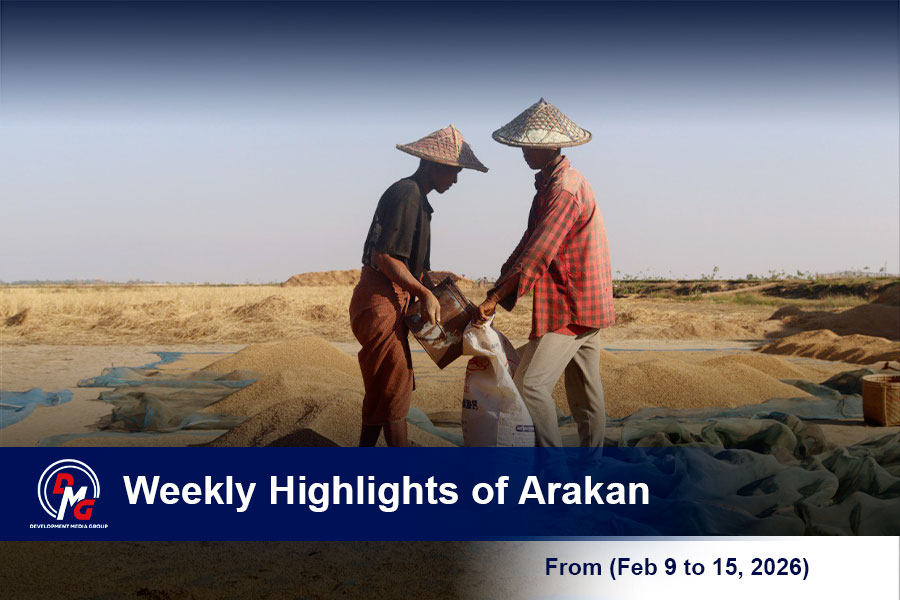
In an era when daily news from Arakan is often fragmented and fast-changing, DMG's Weekly Highlights of Arakan brings clarity, depth, and context to the stories that matter most.
Each week, we round up key political, military, social, and humanitarian developments across Arakan State - connecting the dots between events and offering analysis to help audiences see the bigger picture.
This series is designed for readers and viewers seeking a concise yet comprehensive understanding of how ongoing conflict, governance shifts, and community issues continue to shape lives across Arakan.
Seven civilians, including infant, killed in junta airstrikes on Kyauktaw and Mrauk-U
At least seven civilians were killed and 16 others injured, including several children, in junta airstrikes on Kyauktaw and Mrauk-U on Union Day, February 12. Both towns are currently under the control of the Arakan Army (AA).
The military regime carried out an aerial bombardment on Paikthae Ward in Kyauktaw at around 9:10 p.m., followed by another strike on Alal Zay Ward in Mrauk-U about ten minutes later.
In Kyauktaw, the attack killed two men and two women. Nine others, including women and children, were wounded. In Mrauk-U, three people, including an infant, died, and seven civilians were injured.
Families of the victims are calling for international intervention.
According to DMG data, junta airstrikes in Kyauktaw since April 2024 have resulted in 31 civilian deaths and 102 injuries as of February 12, 2026. This follows a major incident on December 10, 2025, on International Human Rights Day, when a junta airstrike on Mrauk-U Hospital killed 33 civilians and injured 78 others.
ULA purchases paddy from farmers amid market shortage in Arakan State
Authorities from the United League of Arakan (ULA) have begun purchasing paddy this month from townships under the control of the Arakan Army (AA), as local farmers struggle with a lack of buyers and limited market access.
Although it is harvesting season, farmers have faced a stagnant market with little demand, prompting the ULA to intervene and buy the crops.
The United League of Arakan has introduced a pricing system that categorizes paddy into four grades based on quality factors, including grain color, purity, moisture content and the percentage of hollow grains.
Official purchase prices per 100 baskets range from K600,000 to K800,000 for high-grade Paw Hsan Hmwe and from K400,000 to K570,000 for India paddy. Thiridon and Kaukkyi varieties are priced between K420,000 and K600,000, while low-grade paddy is being bought at between K380,000 and K550,000.
To prevent middlemen from reselling paddy, farmers must present a recommendation letter from their village administrator when selling to the ULA/AA.
Last year, 100 baskets of Paw Hsan Hmwe sold for around K750,000, while India paddy fetched about K500,000. However, farmers said the lack of buyers has remained a persistent problem.
Rice and paddy from Arakan State were previously exported to mainland Myanmar and international markets, but trade routes have been disrupted by the military regime’s blockades and ongoing hostilities. As a result, farmers face annual losses due to high input costs and difficulties selling stored produce.
Farmers are urging the Arakan People’s Government to establish a stable and sustainable paddy market to support regional revenue and protect agricultural livelihoods.
Junta torches at least 11 villages in Kyaukphyu Twsp over past year: Residents
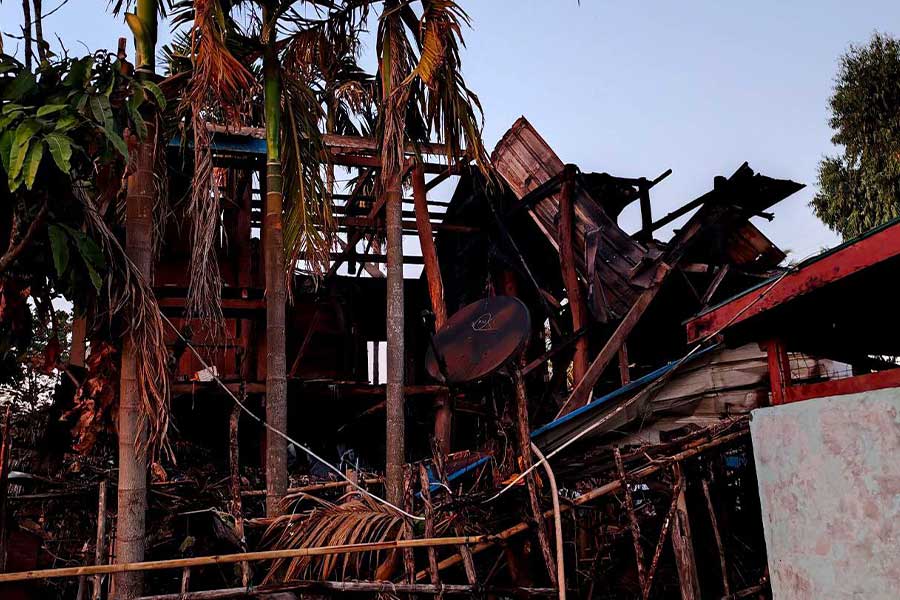
At least 11 villages have been torched and hundreds of homes destroyed in Kyaukphyu Township over the past year since fighting intensified in February 2025, according to local residents.
The township has faced frequent airstrikes, heavy artillery shelling and arson attacks, resulting in daily civilian displacement and widespread property loss.
According to data compiled by DMG, more than 700 houses have been destroyed across at least 11 villages — Ukin, Kyattain, Shaukchaung, Kyanchaing, Katthabyay, Dauntchaung, Pyinshae, Kulabar, Malakyun, Leikkhamaw and Saichonedwein.
Additional fires were reported in Taungyin, Minyatkon and Thayetpin Aut villages on February 9.
On March 6, 2025, a military regime drone strike on Ukin Village destroyed 180 homes. Between March 7 and 12, 2025, the regime carried out four airstrikes on Kyattain Village, destroying 45 houses.
Human rights activists have condemned the destruction of civilian property, describing the targeting of non-combatant areas as “inhumane.”
Casualties and displacement continue to rise as clashes between the military regime and the Arakan Army (AA) persist in Kyaukphyu. The regime has deployed land, sea and air forces in response to AA offensives.
Civil society organizations estimate that more than 60,000 people have been displaced by the fighting in Kyaukphyu.
Arakanese merchants seek access to Indian market via Mizoram trade route
Arakanese merchants are seeking permission to export local products from Arakan State to India through the Mizoram trade route, which they say is a key corridor for cross-border commerce.
While basic commodities are currently imported from India into Arakan State, no local products have yet been approved for export. Traders say establishing bilateral trade would benefit both economies.
At present, hundreds of Arakanese merchants purchase medicines, fuel and basic foodstuffs worth tens of billions of kyats each day from India. However, the absence of exports from Arakan State has created a significant trade imbalance.
Amid intensified fighting for control of towns and food blockades imposed by the military regime, the United League of Arakan/Arakan Army (ULA/AA) established the Mizoram–Arakan trade route in mid-2024 to meet essential needs in Arakan State.
Mizoram, a mountainous state with limited agricultural land, relies on India’s Punjab State for about 90 percent of its food supply, including rice, beans, fish and prawns. Arakanese merchants say sourcing these products from neighboring Arakan State would be mutually advantageous.
Arakan State’s economy is largely based on agriculture and fisheries, producing rice, beans, vegetables, fish, prawns and dried fish, products that merchants are eager to export to India.
Currently, border trade remains limited to imports from India. Merchants say a reciprocal trade agreement between the ULA/AA and Indian authorities would open new markets for Arakanese farmers, fishermen and traders, contributing to regional economic development.
Charcoal sales surge in northern Arakan after AA firewood ban
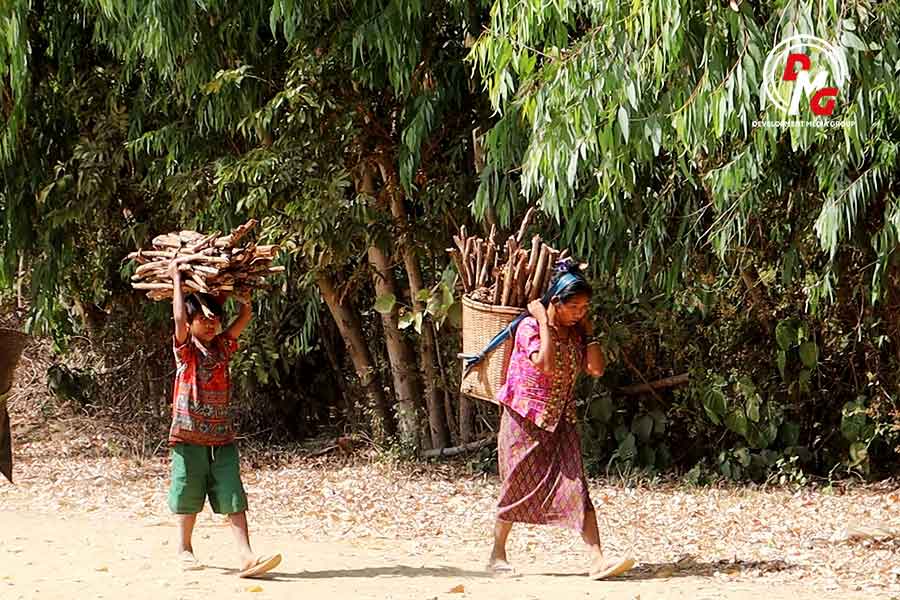
Demand for charcoal has surged and prices have risen following a ban on firewood collection in areas controlled by the Arakan Army (AA), according to local charcoal sellers.
The restriction on cutting firewood for fuel applies to Mrauk-U, Kyauktaw and Ponnagyun townships. As a result, residents are increasingly relying on charcoal to meet their cooking and energy needs.
Charcoal produced in Kyaukphyu and Ann Townships has become the primary fuel source for northern Arakan. In Kyauktaw alone, at least 6,000 bags of charcoal are arriving daily to meet demand.
The current market price for a bag of charcoal ranges from K14,000 to K17,000.
Arakan State has faced power outages for more than two years due to ongoing conflict, leaving residents largely dependent on firewood and charcoal for cooking.
Citing the need to prevent deforestation, the Arakan Army began restricting firewood collection in several northern Arakan townships in January, creating challenges for residents struggling to secure fuel.
Critics say that while the United League of Arakan (ULA) has issued prohibitions aimed at curbing deforestation, it should also implement forest management policies that promote sustainable cultivation and provide alternative fuel options.
While the Arakan Army continues to expand its administrative and judicial mechanisms in areas under its control, observers say policies should be reviewed to better address the hardships faced by civilians.
Although the firewood ban is intended to protect forests, it poses long-term challenges for fuel security in the state.
After Arakan fighting, Taungup residents struggle to rebuild homes
Residents of Taungup whose homes were destroyed during the battle for control of the town continue to face significant challenges in rebuilding their lives, according to local sources.
During the fighting, more than 200 houses and buildings were destroyed by airstrikes, heavy artillery shelling and arson attacks carried out by the Myanmar military regime.
Although some residents have returned to Taungup, those whose homes were destroyed are struggling to rebuild due to soaring commodity prices and mounting economic hardships.
Residents also report difficulties constructing even temporary shelters, as the Arakan Army (AA) has restricted timber extraction across Arakan State.
The destruction was concentrated in Kanpaing, Theintaung and Guta wards, with Kanpaing sustaining the most extensive damage.
Most of those who lost their homes have yet to return and remain displaced in various locations, facing ongoing social and economic hardship as internally displaced persons (IDPs).
As stability gradually returns to townships under Arakan Army control, residents are calling on the authorities to prioritise access to secure shelter.
The Arakan Army seized full control of Taungup Township on December 14, 2024, and is currently carrying out administrative, judicial and rehabilitation processes in the area.
During the latest fighting in Arakan State, thousands of homes and buildings were destroyed, leaving many residents facing the daunting task of reconstruction.

Top News
Weekly Highlights from Arakan State (Feb 9 to 15, 2026)
By Admin 17 Feb 2026
Civilian casualties rise in Kyaukphyu amid junta artillery and airstrikes
By Admin 16 Feb 2026
Junta launches major offensive to retake Tagaung
By Admin 14 Feb 2026



.jpg)