

- Magway records most airstrikes since new military chief took command: ISP-Myanmar
- Junta warship destroys two fishing boats, seizes another off Werathani
- Junta jet fighters drop 500-pound bombs on former junta battalions in Mrauk-U
- Junta deploys fighter jets to bomb Ponnagyun
- Rathedaung villagers set up night watches amid Sittwe clashes, ARSA threat
Regime claims recapture of 19 resistance-held towns: Report
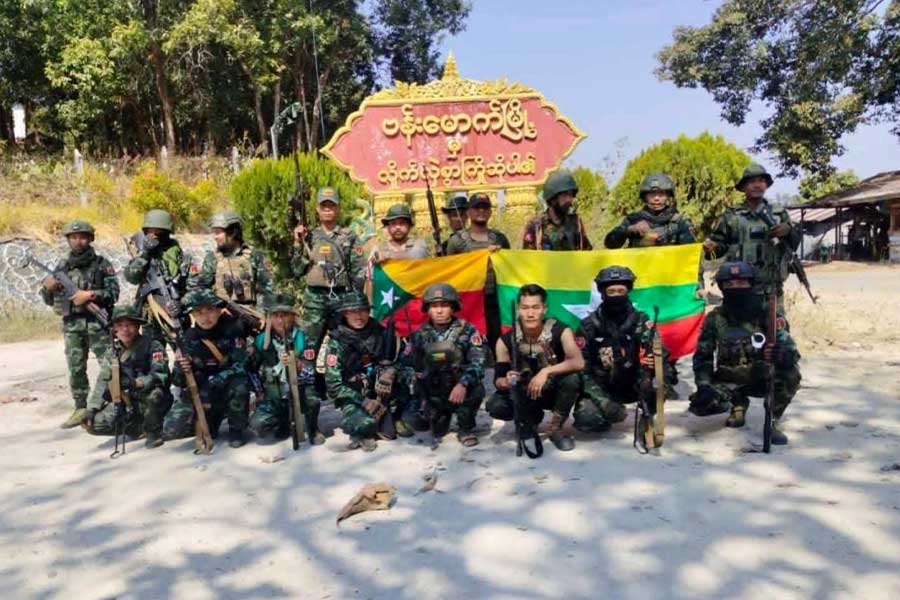
Although resistance forces had seized control of 104 towns across 10 states and regions in Myanmar, the regime has now reportedly recaptured 19 of those towns.
21 May 2026
DMG Newsroom
21 May 2026, Mrauk-U
Although resistance forces had seized control of 104 towns across 10 states and regions in Myanmar, the regime has now reportedly recaptured 19 of those towns.
According to a report released on May 19 by the BNI-Myanmar Peace Monitor, resistance forces captured a total of 104 towns during the post-coup period, including 24 towns in northern Shan State, 24 towns in Arakan State, 16 towns in Chin State, 14 towns in Kachin State, 8 towns in Sagaing Region, 5 towns in Kayah State, 4 towns in Mandalay Region, 2 towns in southern Shan State, 2 towns in eastern Bago Region, and 1 town in Tanintharyi Region.
Data compiled by the BNI-Myanmar Peace Monitor up to May 15, 2026, showed that the regime had recaptured 3 towns in 2024, 9 towns in 2025, and 5 towns in 2026 from resistance forces, totaling 17 towns, while the remaining 87 towns continued to be held by resistance groups.
However, on May 19, the military also recaptured Tonzang Town in Chin State and Mawtaung Town in Tanintharyi Region, bringing the total number of towns regained by the regime to 19.
The BNI-Myanmar Peace Monitor analyzed that airstrikes had become the regime’s primary method for retaking territory and noted that the regime was also reclaiming territory with assistance from China.
Among the recaptured towns, Lashio Town, previously controlled by the Myanmar National Democratic Alliance Army (MNDAA), was identified as the most prominent case.
Furthermore, with Chinese assistance, the regime regained Mogok and Momeik townships, which had been controlled by the Ta’ang National Liberation Army (TNLA) and allied local resistance forces.
Currently, the regime has entered into ceasefire agreements with both the TNLA and MNDAA.
The BNI-Myanmar Peace Monitor analyzed that the ceasefires have allowed regime forces to rebuild and expand their ground offensive capabilities to a certain extent, creating favorable conditions for regaining lost territories.
Although the regime’s recapture of Lashio, Mogok, and Momeik townships has been linked to Chinese assistance, political analysts pointed out that the loss of 14 towns by resistance forces, including Kawlin, Indaw, Falam, and Mawlu, was mainly due to their inability to withstand airstrikes and ground offensives, along with shortages of manpower, weapons, and ammunition.
Political observers also assessed that the regime’s ability to regain control of some lost territories stemmed partly from leadership flaws and miscalculations in military and political decisions among resistance forces.
Political analyst Dr. Sai Kyi Zin Soe stated: “The loss of the towns that were surrendered back involved changes in strategy on the regime’s side. It also included leadership flaws and miscalculations in political and military decisions among the resistance alliances.”
He told DMG: “The most visible factor is China’s mediation. It became a process of re-adjustment after ‘Operation 1027.’ Negotiations were conducted between the EAOs and the regime, resulting in a redistribution of territories regarding which areas should be relinquished.”
Meanwhile, the regime, which has regained some military momentum, is intensifying offensives in Sagaing, Magway, Bago, and Ayeyarwady regions, as well as Chin, Arakan, Kachin, and Kayah states.
The BNI-Myanmar Peace Monitor stated that the regime is likely to launch all-out offensives across land, sea, and air to regain more lost territories, while also potentially using Chinese assistance to pressure resistance forces.

Top News
Magway records most airstrikes since new military chief took command: ISP-Myanmar
By Admin 17 Sep 2026
Junta warship destroys two fishing boats, seizes another off Werathani
By Admin 17 Sep 2026
Junta jet fighters drop 500-pound bombs on former junta battalions in Mrauk-U
By Admin 17 Sep 2026

JFM calls for Myanmar military to be barred from ARF drone workshop
By Admin 17 Sep 2026
Junta deploys fighter jets to bomb Ponnagyun
By Admin 17 Sep 2026


.jpg)