
- Junta bombings kill 27 civilians, injure 38 across Arakan State, Paletwa in two weeks: DMG tally
- Digital repression persists across junta, resistance-held areas, MIP reports
- Thefts rise across Arakan Army-held areas
- Junta airstrikes cause 11 mass-casualty incidents in Arakan State this year
- Displacement crisis in Karenni State forces immediate landmine clearance
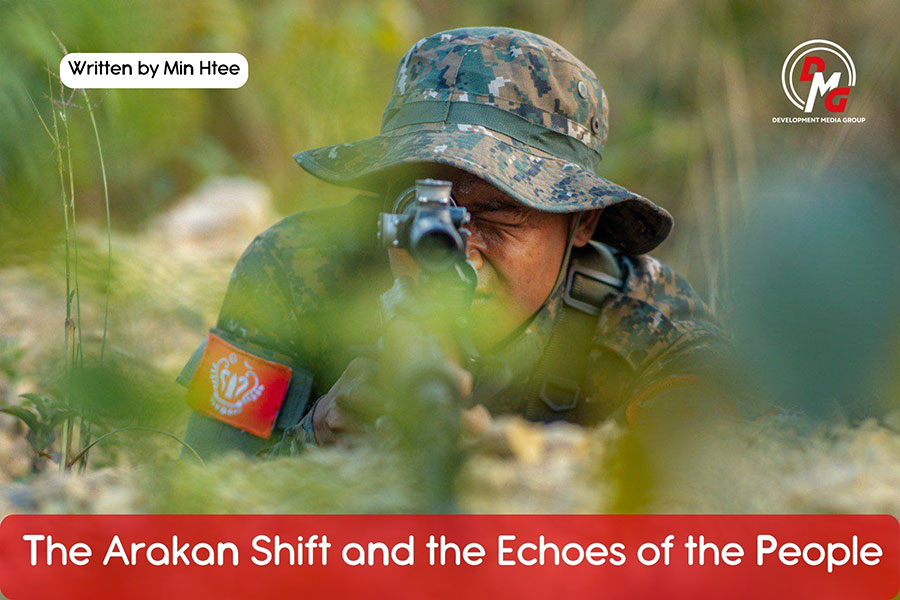
The Arakan Shift and the Echoes of the People
Today, I chose the phrase “The Political Shift in Arakan and the Echoes of the People.” What I want to discuss is the current situation in Arakan, the expectations of Arakan’s leaders, and the political and revolutionary trajectory of the Arakan people. In this article, I intend to briefly present the major realities I am currently observing.
13 May 2026
Written by Min Htee
Today, I chose the phrase “The Political Shift in Arakan and the Echoes of the People.” What I want to discuss is the current situation in Arakan, the expectations of Arakan’s leaders, and the political and revolutionary trajectory of the Arakan people. In this article, I intend to briefly present the major realities I am currently observing.
Many people have likely already read the recent interview between the Commander-in-Chief of the Arakan Army and the India-based journal The Diplomat. One statement made by the Arakan Army commander stands out. He said that if the current government led by Min Aung Hlaing wants to negotiate a return to the pre-2023 situation, then the Arakan Army would discuss returning to the pre-1784 situation before the Arakan Kingdom fell under Burmese rule.
Viewed in the context of present realities, these remarks suggest that genuine political dialogue remains unlikely in the near future. On the other hand, Min Aung Hlaing, now serving as president, continues calling on revolutionary groups to surrender and “return to the legal fold.” This demonstrates that Myanmar’s military leadership still lacks any real desire to resolve the country’s conflict through political means.
Therefore, under Myanmar’s current conditions, it appears inevitable that peace will continue to be pursued through armed struggle. Whether the public accepts this reality or not is another matter. Ever since the military seized power, it has been clear that the people do not accept military rule. Since the 2021 coup, the Arakan Army has captured 14 townships in Arakan State, along with Paletwa Township in Chin State. Among the more than one hundred revolutionary organizations currently active in Myanmar, the Arakan Army has emerged as both one of the most successful and one of the most influential revolutionary forces.
In 2025, Myanmar’s military enacted the conscription law and began forcibly recruiting soldiers. During the same period, some revolutionary armed groups also initiated recruitment campaigns. This triggered dissatisfaction among certain sections of the public. Some people may not fully accept the reality that Myanmar’s revolutionary struggle has reached a stage where force must be balanced with force. However, organizations unable to build sufficient strength will inevitably face defeat by the military. That is simply the reality.
In Arakan, the “Arakan People’s Revolutionary Government” has already been established and is administering territories controlled by the Arakan Army. At present, the military junta controls only the urban areas of Sittwe, Kyaukphyu, and Manaung Island. In practical terms, the Arakan People’s Revolutionary Government now administers roughly 90 percent of Arakan territory.
Since Min Aung Hlaing became president, Myanmar’s military has also altered its airstrike tactics. Unlike earlier periods when single aircraft bombed civilian areas, the military now deploys groups of three to ten aircraft in coordinated attacks. Since Operation 1027 began in November 2023, the military has continuously pressured Arakan through air power while simultaneously blocking trade routes.
After capturing 14 of 17 townships in Arakan State, the Arakan Army appears to have reduced military operations within Arakan itself while increasing military pressure toward western Magway Region and the Ayeyarwady region.
Kyaukphyu and Sittwe are also major strategic areas tied to large-scale Chinese and Indian investment projects. Kyaukphyu is central to China’s Belt and Road Initiative, while Sittwe is important to India’s “Act East” and Kaladan-related strategic ambitions. These two cities remain outside Arakan Army control and continue to serve as military strongholds for the junta, which uses them to reinforce troops and weapons supplies.
The lack of prospects for political negotiations between the Arakan Army and the current government suggests that Myanmar’s military may attempt another major military operation. One possibility could involve launching large-scale offensives from Kyaukphyu and Sittwe using naval and air power. Even if such operations do not occur immediately, they remain scenarios that must be anticipated. Myanmar’s military previously failed to properly assess the battlefield in Arakan, resulting in significant losses.
Today, the Arakan Army is not only fighting battles but also operating a functioning governing system in Arakan. It must now shoulder responsibilities related to defense, security, development, healthcare, and administration, while continuing ongoing revolutionary offensives. Although the Arakan Army may possess sufficient offensive capability, defensive manpower requirements are likely growing rapidly. Thousands of troops are needed along the Bangladesh border, while forces must also be distributed from the Ayeyarwady border to Chin State.
This period may therefore become not only a decisive phase, but also one of the most dangerous periods Arakan has ever faced. It is highly possible that Myanmar’s military will intensify pressure and military operations. Meanwhile, revolutionary momentum in central Myanmar appears to be weakening under military propaganda campaigns and sustained airstrikes.
In reality, a strong revolutionary movement in central Myanmar could significantly weaken the military. However, internal divisions, factionalism, and the absence of inclusive leadership threaten the long-term strength of the resistance there. Whether these revolutionary forces can withstand future military pressure remains uncertain and will largely depend on their ability to replenish and sustain manpower and resources.
Turning back to Arakan, the military’s recent recapture of Falam in Chin State from the Chin Brotherhood (CB) group effectively knocks on Arakan’s northern gateway. Falam is strategically important because it connects northern and southern Chin State. Even if Chin resistance forces remain strong in the south, the military may attempt broader strategic operations through northern Chin areas toward the Indian border.
During this same period, the Arakan Army detained groups of young people attempting to leave Arakan in large numbers. This sparked criticism and dissatisfaction across social media. In many ways, this controversy reflects broader tensions between Arakan’s youth and the realities of today’s revolution.
Regardless, young people must understand the realities currently facing Arakan. The issue today is not simply patriotism or nationalism, but whether people accept the leadership’s strategic calculations and preparations. Rather than seeking temporary escape from war, it is more important to confront and address the deeper political realities.
When Israel was attacked in 2024, Jewish youth from around the world volunteered to join the military. Likewise, today’s situation in Arakan directly concerns the youth of Arakan itself. Defending Arakan is the responsibility of all Arakanese people.
Ultimately, Myanmar’s conflict will not escape war unless genuinely secure liberated territories are built and defended with sufficient strength. Political dialogue culture has never truly flourished in Myanmar since the communist insurgencies began in 1948. Even if political talks eventually emerge, Myanmar’s military will likely continue negotiating from a position of dominance.
Therefore, the Arakan Army’s vision and the people’s belief in the full liberation of Arakan cannot be secured merely by capturing territory. Broad public participation is essential. The government must listen carefully to the echoes and concerns of the people, while also preparing systematically for future threats. Strengthening trust between the Arakan public and the government is critically important.
For the people themselves, the liberation of Arakan more than local disputes or divisions remains the key path toward long-term security, peace, and development for the entire Arakan population.

Opinion
Securing Rights for Bangladesh's Indigenous Peoples is Indispensable
By Admin 09 Aug 2026

Reflections on the Arakanese (Rakhine) Language Curriculum
By Admin 14 Jul 2026
Holding On to Arakan
By Admin 26 Jun 2026
The Arakan Shift and the Echoes of the People
By Admin 13 May 2026
We Must Remove What Is No Longer Needed
By Admin 24 Apr 2026
POLITICS

BUSINESS
Industry to manufacture finished goods from coconut starting in early 2020
By Aung Kaung Zaw 20 Nov 2019