
- Magway records most airstrikes since new military chief took command: ISP-Myanmar
- Junta warship destroys two fishing boats, seizes another off Werathani
- Junta jet fighters drop 500-pound bombs on former junta battalions in Mrauk-U
- Junta deploys fighter jets to bomb Ponnagyun
- Rathedaung villagers set up night watches amid Sittwe clashes, ARSA threat
The Rhythms of War
“Are we Arakan people all going to become traders and merchants? Will our people stop studying altogether? It is impossible for an entire nation to live without education. One day, everyone will study again. No matter how long it takes, no matter how long we go without salaries, I will wait for that day.”
16 Mar 2026
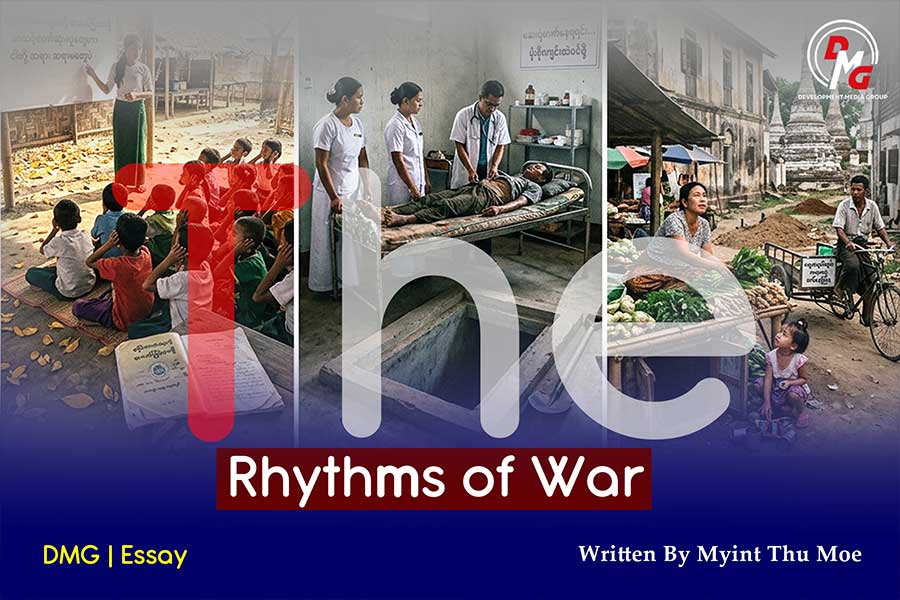
DMG | Essay
Written By Myint Thu Moe
Falling leaves,
and the melancholic calls of cuckoo birds
these are the rhythms of summer.
Thunder rumbling,
rivers overflowing
these are the rhythms of the rainy season.
Mist and frost,
the biting chill that makes the body tremble
these are the rhythms of winter.
Since the end of 2023, because of the war across Arakan State in western Myanmar, teachers and students in towns where fighting broke out have all lost their way. Then, beginning in early 2024, government employees in those war-affected towns had their salaries suspended.
As a result, government workers suddenly found themselves without income, while the prices of basic goods rose nearly tenfold compared to before the war. Some began traveling to India in search of work. Others turned to selling goods at ports.
But one schoolteacher had no interest in traveling to India. He had no desire to sell goods in the port markets either.
Inside his mind, inside his heart, deep within his very being, only one thought had taken root.
The thought was this:
“Are we Arakan people all going to become traders and merchants? Will our people stop studying altogether? It is impossible for an entire nation to live without education. One day, everyone will study again. No matter how long it takes, no matter how long we go without salaries, I will wait for that day.”
Alongside that thought, another belief had taken hold in his heart: “Anyone with capital and strength can run a business. But not everyone can teach children. Even the richest person cannot easily do the work of educating children. The most suitable people to teach Arakan children in Arakan are us, the teachers.”
With those two convictions, the day he had been waiting for finally arrived around the middle of 2024, when the Arakan People’s Revolutionary Government began implementing plans to reopen education.
Students were happy to return to school. Yet walking to school and back home now carried a new responsibility the constant fear of jet fighters.
Even during lessons, teachers and students alike had developed the habit of pausing again and again to listen carefully for the sound of approaching jets.
The same was true elsewhere.
Doctors, nurses, and patients inside hospitals all listened anxiously for the sound of jets.
Vendors selling goods in markets listened for the sound of jets as they worked.
Housewives cooking in their kitchens listened for the sound of jets while preparing meals.
Ice-pop vendors pushing carts through the streets listened for the sound of jets as they sold their goods.
Elderly people observing religious precepts listened for the sound of jets as they prayed.
Motorcycle taxi drivers listened for the sound of jets while driving passengers.
Children playing along the roadside listened for the sound of jets even as they played.
Perhaps not only the people of Arakan, but even the dogs, cats, and birds have learned to listen for the sound of jets.
Why does everyone tremble with such fear at that sound?
Because in towns where fighting has taken place, bombs dropped from jets have killed Arakanese civilians in numbers too many to count.
In cemeteries across Arakan State, the graves of those killed by bombs are increasing day by day.
Every resident of Arakan sees and lives through these tragedies.
And yet, even while grieving for the dead and trembling with fear at the sound of jets, the people of Arakan continue moving forward continuing their journeys in education, healthcare, and economic survival.
Their lives do not feel like dreams.
They feel like recurring nightmares.
Not legends yet strangely legendary.
Perhaps, though not dreams or myths, the people of Arakan are writing a new chapter of history that will one day be remembered.
In that history there may be a chapter about their current lives:
running to keep up with soaring prices, while always being ready at any moment, in any place to jump into the nearest ditch on the way to school, hide beneath hospital beds while receiving treatment, dive into bomb shelters dug beside market stalls while selling goods, rush into bunkers inside their homes while eating dinner, or wake suddenly from sleep to seek shelter.
These are the lives of the people of Arakan today.
Falling leaves
and the sorrowful calls of cuckoo birds
the rhythms of summer.
Thunder rolling
and rivers flooding
the rhythms of the rainy season.
Frost and mist
and the shivering cold
the rhythms of winter.
But now bombs fall anywhere, at any time.
While selling goods, people recite prayers for refuge.
While walking to school, people recite prayers for refuge.
While receiving medical treatment in hospitals, people recite prayers for refuge.
And the lives of the people of Arakan have become the rhythms of war.

Opinion
.jpg)
How Can Myanmar’s Political Crisis Be Brought to an End?
By Admin 13 Sep 2026
By Cutting Trees, We Are Killing Ourselves
By Admin 06 Sep 2026
A Modern August We Must Never Forget
By Admin 31 Aug 2026
Arakan’s Political Shifts and the Debate Over Rights and Governance
By Admin 27 Aug 2026
Securing Rights for Bangladesh's Indigenous Peoples is Indispensable
By Admin 09 Aug 2026
POLITICS

BUSINESS
Industry to manufacture finished goods from coconut starting in early 2020
By Aung Kaung Zaw 20 Nov 2019