
- Magway records most airstrikes since new military chief took command: ISP-Myanmar
- Junta warship destroys two fishing boats, seizes another off Werathani
- Junta jet fighters drop 500-pound bombs on former junta battalions in Mrauk-U
- Junta deploys fighter jets to bomb Ponnagyun
- Rathedaung villagers set up night watches amid Sittwe clashes, ARSA threat
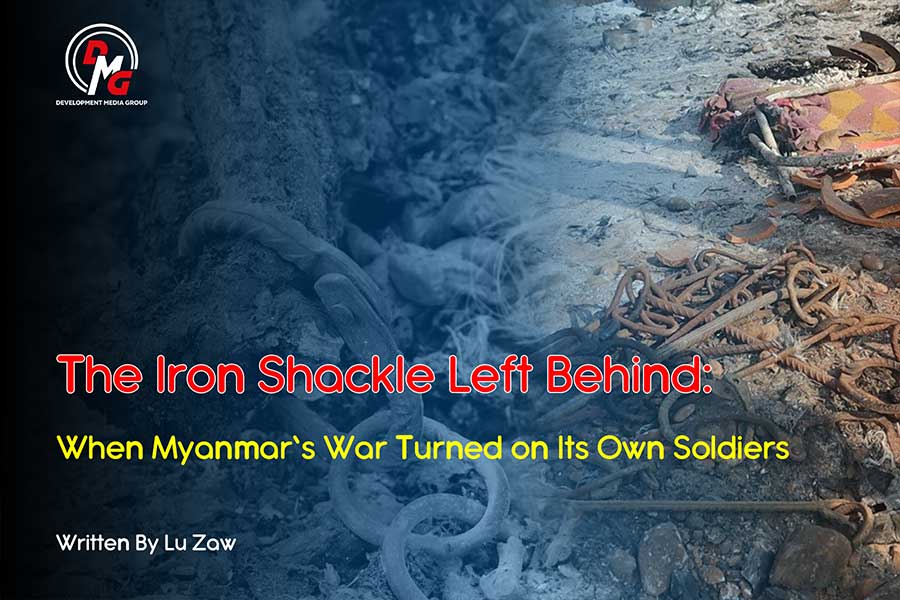
The Iron Shackle Left Behind: When Myanmar’s War Turned on Its Own Soldiers
A photograph of a burned body stripped of identity, stripped of pride, stripped even of sensation has painfully captured the public’s attention following the attack on the Darlatchaung prisoner-of-war detention camp.
23 Mar 2026
Written By Lu Zaw
A photograph of a burned body stripped of identity, stripped of pride, stripped even of sensation has painfully captured the public’s attention following the attack on the Darlatchaung prisoner-of-war detention camp.
On a half-burned ankle, one iron shackle remains.
That iron shackle is proof that the person was a prisoner. Among those who died were many prisoners of war.
The owner of that iron shackle may once have been a soldier who believed he was defending his country. In the early mornings inside military compounds, he may have stood shoulder to shoulder with his comrades before the national flag, solemnly reciting the soldier’s oath.
Later, he may have left the barracks and gone to the front lines in ethnic regions. He may have witnessed countless battles, countless deaths, and countless scenes of horror. In remote places, he may have taken part in arrests, killings, or the disappearance of bodies. In some moments, perhaps he even tried to stand on the side of humanity and truth.
Perhaps he joined the army to protect the nation from danger. Or perhaps he joined simply because he had no livelihood and saw the military as his only path.
The owner of that iron shackle may have graduated from a military academy or he may have had only a primary-school education. He had a hometown, a mother and father, brothers and sisters, and relatives. He likely had children and a wife who loved him. His family may once have waited for the day he would return from the barracks.
Or perhaps, like him, his family too are now prisoners.
But according to the photograph now circulating among the public, the burned fragment of a shinbone is no longer enough for his family to recognize him. Even the iron shackle that bound him cannot tell us who he was.
Yet one thing is certain.
He was once a soldier in the Myanmar military, an army dominated by cruelty and violence. Later, after losing in battle, he became a prisoner of war. The iron shackle is the clearest proof of that.
Once, he was a soldier who faithfully carried out orders through every level of command and responsibility. He likely loved his superiors, his subordinates, and the institution he served. He may even have been willing to give his life for his army.
He trusted his commanders. He believed in the institution he called the Tatmadaw.
Even while living in hardship in a prison camp among fellow prisoners, he may still have believed in the army he admired all his life. Perhaps he imagined heroic scenes like those from films he watched as a young man, soldiers risking their lives to rescue comrades behind enemy lines.
But on March 8, 2026, he may have learned the ultimate truth about the loyalty he had given his entire life.
The army he loved. The leaders he respectfully called “Father.”
Those were the same people who dropped bombs on him.
According to testimonies from surviving prisoners, reconnaissance aircraft had flown over the camp for days, gathering intelligence before launching a precise attack. They knew it was a prison. They knew that many of their own captured soldiers were being held there.
Yet they still dropped bomb after bomb.
Even before this attack, similar incidents had occurred.
On January 20, the Chaung Tu prisoner-of-war camp was bombed, killing 21 people, including prisoners’ family members and children, and injuring 30 others.
On January 18, 2025, an airstrike on a prisoner camp in Mrauk-U Township killed 28 prisoners and family members and injured 27.
On September 8, 2024, an airstrike on a POW camp in Pauktaw Township killed 17 prisoners and wounded more than ten others.
On September 9, 2024, the bombing of a Border Guard Police base in Maungdaw Township killed more than 60 prisoners and injured many others.
The owner of the iron shackle lying burned and lifeless likely knew all of these stories.
Even then, he probably never believed that the army he loved would do the same thing to him.
But in his final moments, he must have accepted the truth: the bombs falling from the sky were dropped by the very army he had trusted all his life.
Captain Aung Myo Myat later recalled the horror of that day. Hearing the desperate cries of his fellow soldiers shouting “Help us! Save us!” nearly brought him to tears.
Many prisoners were not killed directly by shrapnel. Instead, bombs set the prison buildings on fire, trapping detainees inside iron-barred cells. The iron shackles chained to their ankles prevented escape.
What words did the owner of that half-burned ankle cry out in those final moments?
How did he curse the army he had trusted all his life?
The soldier’s oath declares:
“We shall remain loyal and respectful to the State and its citizens.
We shall honor the loyalty of fallen soldiers.
We shall faithfully carry out the duties and orders given to us.
For my State, my people, and my army, I pledge to sacrifice my life.”
But when soldiers no longer behave like soldiers, loyalty becomes nothing more than painted words on a signboard outside a barracks.
Those who were meant to protect the country and its people have instead committed inhumane acts against them. In the name of honoring fallen soldiers, they oppress civilians. Soldiers who faithfully carried out orders are now destroyed by fellow soldiers as if they were enemies.
This war is not a war for the country or the people.
It is a war fought for the interests of a small group of dictators.
It is a war in which others are sacrificed so that a handful of military rulers and their families can continue to live comfortably.
The nameless owner of the iron shackle surely understands that truth now.
While captured soldiers die in agony and their families grieve, the pilots who dropped bombs on their comrades may be sitting comfortably watching the news. Those who ordered the mass killing may be living peacefully with their families at home.
One video message from Colonel Thet Htoo San to his family showed both compassion and hope.
He said: “The authorities here have told us that when the time comes they will release the detainees. So we are waiting here with the belief that we will survive and one day meet our families again.”
He also said he was alive and well.
If his family sees that video, what will they feel?
Colonel Thet Htoo San, along with many captured officers and soldiers, may now understand the true nature of the war they once fought.
In other videos, survivors sat in stunned silence, asking how the army they once respected could do such a thing.
These were soldiers who fought with everything they had and surrendered only when there was no other choice. Far from their families, stripped of rank and authority, they lived in hardship and captivity sustained only by the hope of returning home one day.
Now nearly 160 prisoners have been killed by repeated bombing runs from eight aircraft.
Were they treated as traitors?
Or were they silenced because they knew too much about the cruelty of military leaders?
Those who still believe they are faithfully serving a noble institution should reflect carefully.
This may be the moment to lower the rifles pointed at the people.
The white flag is a symbol of peace.
If soldiers truly honor the sacrifices of their comrades, then they should stand with the people.
Families are waiting at the barracks.
Soldiers on the front lines are exhausted.
The country itself has been shattered by a small group of dictators.
You are now killing the very comrades you once called brothers.
If you truly think about it, the truth may be closer than you realize.
The owner of that burned ankle may once have been a disciplined soldier loyal to his army, decorated with honors and medals.
But he did not die defending Myanmar from foreign invaders.
He died anonymously among many others killed by bombs dropped by the very army he loved.
All he left behind was a single iron shackle.
What remains in the memory of the people is the half-burned ankle and the iron shackle that once bound him.
Perhaps that iron shackle is the final symbol of the loyalty he gave to the army he loved.
If only the iron rings of that shackle could speak, perhaps they would tell us the final truth about whether this war is just.

Opinion
.jpg)
How Can Myanmar’s Political Crisis Be Brought to an End?
By Admin 13 Sep 2026
By Cutting Trees, We Are Killing Ourselves
By Admin 06 Sep 2026
A Modern August We Must Never Forget
By Admin 31 Aug 2026
Arakan’s Political Shifts and the Debate Over Rights and Governance
By Admin 27 Aug 2026
Securing Rights for Bangladesh's Indigenous Peoples is Indispensable
By Admin 09 Aug 2026
POLITICS

BUSINESS
Industry to manufacture finished goods from coconut starting in early 2020
By Aung Kaung Zaw 20 Nov 2019