

- Junta airstrikes lead Myanmar conflict incidents: NLTA’s conflict diary
- Six civilians killed, 16 injured in Arakan attacks over 11 days: AA
- Regime deploys nearly 100 police personnel to Sittwe amid intense fighting
- Junta airstrikes on Kyeintali Town, nearby village injure two civilians
- AA clashes with ARSA in northern Maungdaw
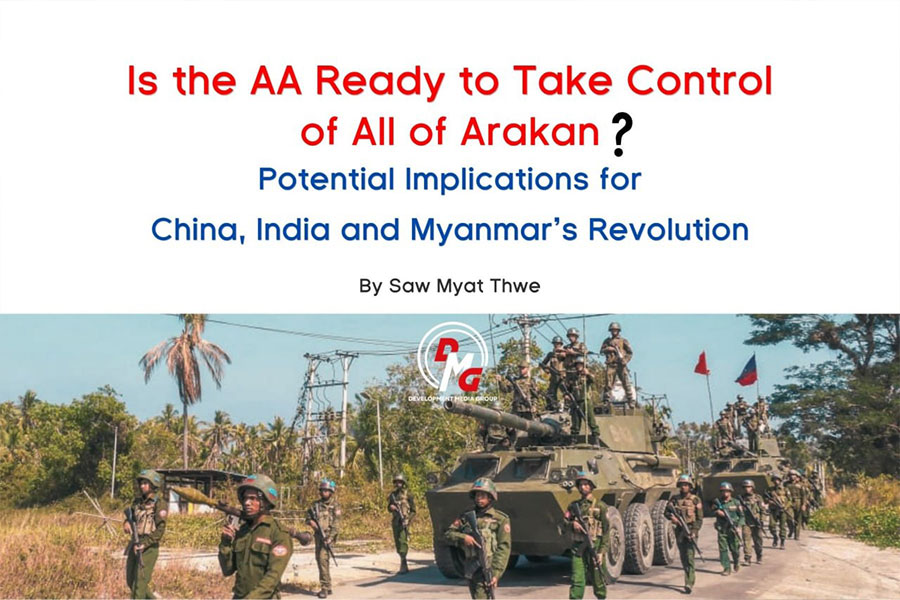
Arakan Army’s Gains and the Changing Geopolitics of Arakan
For decades after Myanmar gained independence, the country was unable to free itself from the military’s domination of political power. The people of Myanmar, too, repeatedly suffered the consequences of successive military dictatorships.
29 Sep 2026
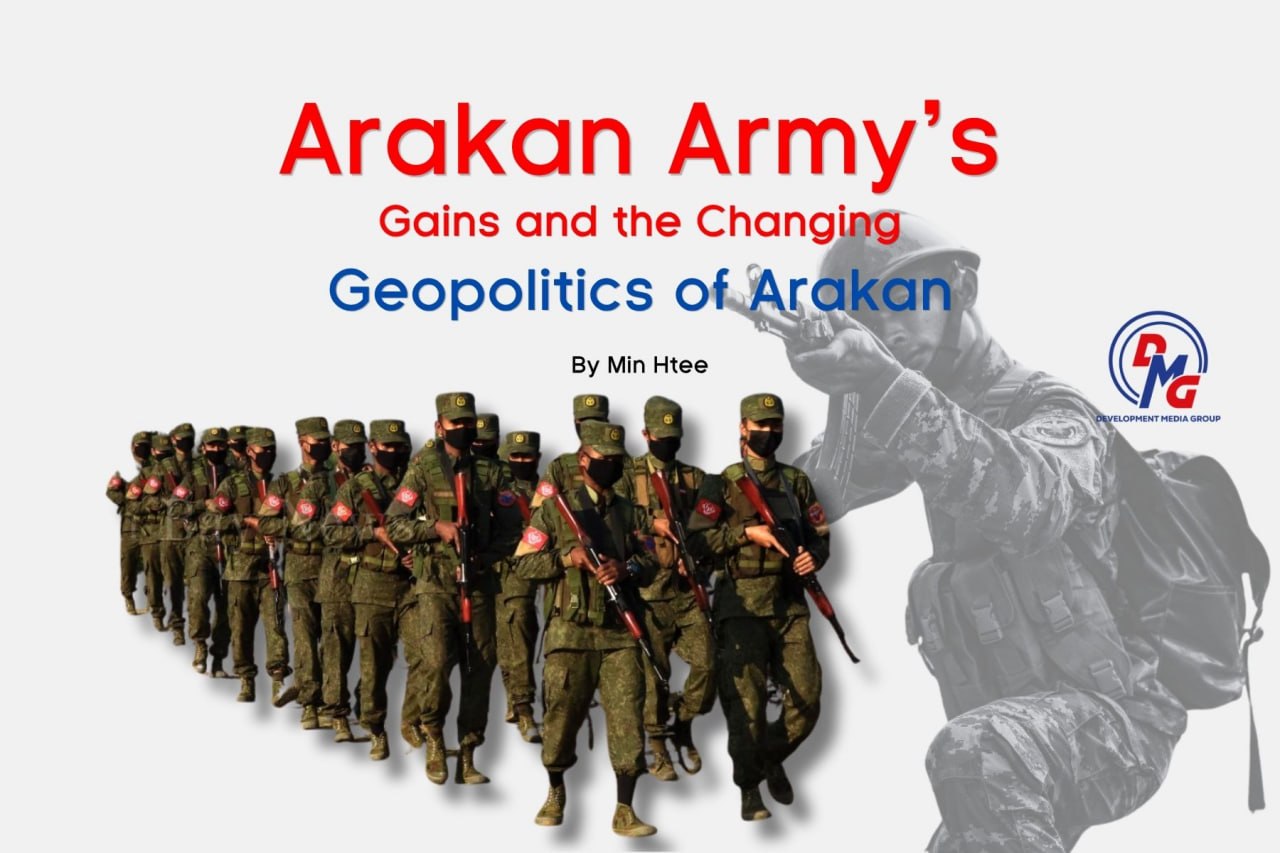
By Min Htee
For decades after Myanmar gained independence, the country was unable to free itself from the military’s domination of political power. The people of Myanmar, too, repeatedly suffered the consequences of successive military dictatorships.
Under the military rule of Senior General Than Shwe, the Myanmar military sought to restructure its political power in a different form. The political system was rebuilt around the 2008 Constitution, and following the 2010 election, the military-aligned Union Solidarity and Development Party (USDP) formed a government.
Military rule subsequently took on the appearance of civilian government, but the military’s political power did not disappear.
That situation, however, gradually began to change following the 2012 by-election. The political strength of the National League for Democracy (NLD) and Daw Aung San Suu Kyi, who enjoyed widespread public support, continued to grow. In the 2015 election, the NLD won a landslide victory and formed a government.
From that point onward, Myanmar’s political balance of power was no longer concentrated solely in the hands of the military. It increasingly shifted toward a government that had come to power through the popular vote.
When the NLD won again in the 2020 election, this shift in the balance of power became even clearer. Then, in February 2021, the military seized state power again, plunging Myanmar into another major political crisis.
Defying Military Rule
People opposed to the military takeover took to the streets in protest. The military responded with violent crackdowns on its opponents, and many people lost their lives during the protests and the armed resistance that followed, while thousands were arrested.
After that, many young people across Myanmar turned to armed resistance, and the conflict spread more widely across the country. Ethnic armed groups representing the Kachin, Karen, Karenni, Kokang, Ta’ang and Arakan, among others, also fought the military regime, while armed resistance gradually gained strength nationwide.
One of the major events that significantly changed Myanmar’s military and political geography was Operation 1027, launched on October 27, 2023, by the Three Brotherhood Alliance: the Myanmar National Democratic Alliance Army (MNDAA), the Ta’ang National Liberation Army (TNLA) and the Arakan Army (AA).
During Operation 1027, the MNDAA and TNLA progressively captured territory across northern Shan State. The MNDAA took control of important areas including Chinshwehaw, Laukkai, Kunlong and Hsenwi, and in 2024 it also captured Lashio. The TNLA likewise gained control of important towns and townships in northern Shan State, including Namkham, Namhsan, Mantong, Namtu, Momeik, Kyaukme and Nawnghkio.
But one of the most significant consequences of Operation 1027 became even more apparent in Arakan.
Soon after Operation 1027 began, the Arakan Army resumed its offensive in Arakan and, during 2024 and 2025, gained control of most of the state’s townships. After December 2024, the United League of Arakan/Arakan Army (ULA/AA) also came to control the border with Bangladesh and captured the Myanmar military’s Western Command headquarters.
The Arakan Army’s Military Gains and Geopolitics
At this point, we need to look at just how important Arakan has become geopolitically.
Arakan is more than simply a state on Myanmar’s western edge. In the current situation, it has become a strategic region where China’s interest in access to the Indian Ocean, India’s interest in connectivity with its northeast, and Bangladesh’s border-security interests converge.
The fact that the Arakan Army has gained control over much of the important territory within this strategic space means that its advances can no longer be viewed simply as battlefield gains. Military strength has also created the potential for greater political and economic leverage.
According to an analysis by Armed Conflict Location & Event Data (ACLED), the AA controls all or parts of areas containing major foreign investment projects in Arakan, giving it an increasingly important strategic position in its dealings with China and India.
ACLED reported that, as of December 2024, two of 11 major Chinese-backed projects were located entirely within AA-controlled territory, while eight were partly within areas under its control.
This is particularly significant along the Myanmar-Bangladesh border. The situation has shifted from one in which Naypyidaw was the only authority that needed to be considered to one in which the ULA/AA must also be taken into account as a de facto authority exercising power on the ground.
This new reality also means that the ULA/AA’s role can no longer be left out of efforts to address the issue of Muslim refugees along the Arakan-Bangladesh border.
On the other hand, if we look at India’s Kaladan Multi-Modal Transit Transport Project, Arakan’s strategic importance becomes even more apparent.
Paletwa and the routes inside Arakan connected to the Kaladan project are now directly linked to the Arakan Army’s territorial control. The future of the project, therefore, can no longer be considered separately from the military and political situation unfolding in Arakan.
China also has major interests in the region, including the Kyaukphyu deep-sea port and oil and natural gas pipelines. As the Arakan Army’s territorial control has expanded, the ULA/AA’s role has become increasingly important to the continued implementation of these projects.
ACLED has similarly assessed that the AA’s territorial control in Arakan has created a situation in which China and India must take the organization into account if they want to continue implementing their projects in the region.
At the same time, the ULA/AA has been building administrative structures alongside its territorial control. The expansion of its own systems of administration in areas including justice, governance, healthcare, education and social services can be seen as an attempt to transform military gains into administrative authority.
ACLED has also assessed that the ULA/AA has built administrative mechanisms alongside its territorial control and has increasingly established itself as an authority in the region.
For that reason, the Arakan Army’s current position can no longer be measured simply by how many towns it has captured on the battlefield. The ULA/AA is gradually moving from territorial control toward building administrative authority, while also assuming an increasingly important position in terms of its relationship with the population, the construction of political authority and regional geopolitics.
So the question now is not simply how much military success it has achieved. The more important question is how far it can transform territorial control into political and administrative authority.
In the current situation, China and India can no longer think about Arakan’s future while viewing the ULA/AA merely as another ethnic armed organization (EAO).
Analyses of regional geopolitics by the S. Rajaratnam School of International Studies (RSIS) and Pacific Forum have also described the AA as a de facto authority in Arakan.
Looking at Arakan’s geopolitics from China’s perspective, the region is important because of the Kyaukphyu deep-sea port, the oil and natural gas pipelines, and its place in the China-Myanmar Economic Corridor (CMEC) linking China’s Yunnan Province with the Bay of Bengal.
For India, Arakan is also strategically important to its Act East Policy and its efforts to improve connectivity with northeastern India.
The Arakan Army’s military gains and territorial control are therefore also changing Arakan’s geopolitical position, while the ULA/AA is becoming a political force that cannot be ignored when considering Arakan’s future.
Conclusion
The Arakan Army’s current military gains are not simply about a change in territorial control within Arakan. They are also changing Arakan’s geopolitical position.
In particular, in a region where the strategic interests of China, India and Bangladesh converge, the ULA/AA has become a regional authority that can no longer simply be ignored.
For China, India and Bangladesh, therefore, the question is no longer just, “Should we recognise the ULA/AA or not?” The more important questions are how they engage with and communicate with the ULA/AA, which now exercises considerable power and influence on the ground, and how they balance their national interests with regional stability.
For China, the continued implementation of strategic projects including the Kyaukphyu deep-sea port and the oil and natural gas pipelines is a major concern. Given this reality, it is no longer possible to think about Arakan’s future while excluding the ULA/AA, which exercises significant control on the ground.
China increasingly needs to consider its relationship with the ULA/AA not only in terms of project security but also in connection with Arakan’s long-term stability.
The situation is similar for India. Because Arakan is strategically important to the Kaladan project and India’s efforts to improve connectivity with its northeastern region, it is increasingly difficult to pursue that connectivity while ignoring the ULA/AA’s territorial control.
India therefore increasingly has to understand the ULA/AA not simply as an armed organization, but as part of the changing balance of power on the ground in Arakan.
For Bangladesh, the situation is even closer to home and more complicated. Border security, trade and, in particular, issues concerning the Muslim population have become directly connected to territory controlled by the ULA/AA.
Bangladesh therefore cannot easily avoid dealing with the ULA/AA, and the reality of the organization’s authority on the ground increasingly has to be taken into consideration when addressing border security and issues concerning the Muslim population.
Ultimately, the geopolitical transformation of Arakan is not simply a story of the ULA/AA’s gains. It also means that China, India and Bangladesh are facing a situation in which they have to reassess their policies in response to changing realities on the ground.
Rather than avoiding or refusing to acknowledge the changed balance of power in Arakan, understanding that reality and deciding how to engage with it has become increasingly important.
For China, India and Bangladesh in particular, relations with the ULA/AA are becoming an important strategic consideration that could have significant implications for Arakan’s future political, economic and security landscape.

Opinion
Arakan Army’s Gains and the Changing Geopolitics of Arakan
By Admin 29 Sep 2026
Beyond Military Victory: What Is Myanmar’s Ultimate Political Objective?
By Admin 26 Sep 2026
UN at a Crossroads: Six Priorities for a Shared Future
By Admin 23 Sep 2026
.jpg)
How Can Myanmar’s Political Crisis Be Brought to an End?
By Admin 13 Sep 2026

By Cutting Trees, We Are Killing Ourselves
By Admin 06 Sep 2026
POLITICS



BUSINESS
Industry to manufacture finished goods from coconut starting in early 2020
By Aung Kaung Zaw 20 Nov 2019