
- Junta airstrikes lead Myanmar conflict incidents: NLTA’s conflict diary
- Six civilians killed, 16 injured in Arakan attacks over 11 days: AA
- Regime deploys nearly 100 police personnel to Sittwe amid intense fighting
- Junta airstrikes on Kyeintali Town, nearby village injure two civilians
- AA clashes with ARSA in northern Maungdaw
Weekly Highlights from Arakan (September 21-27, 2026)
In an era when daily news from Arakan is often fragmented and fast-changing, DMG's Weekly Highlights of Arakan brings clarity, depth, and context to the stories that matter most.
28 Sep 2026
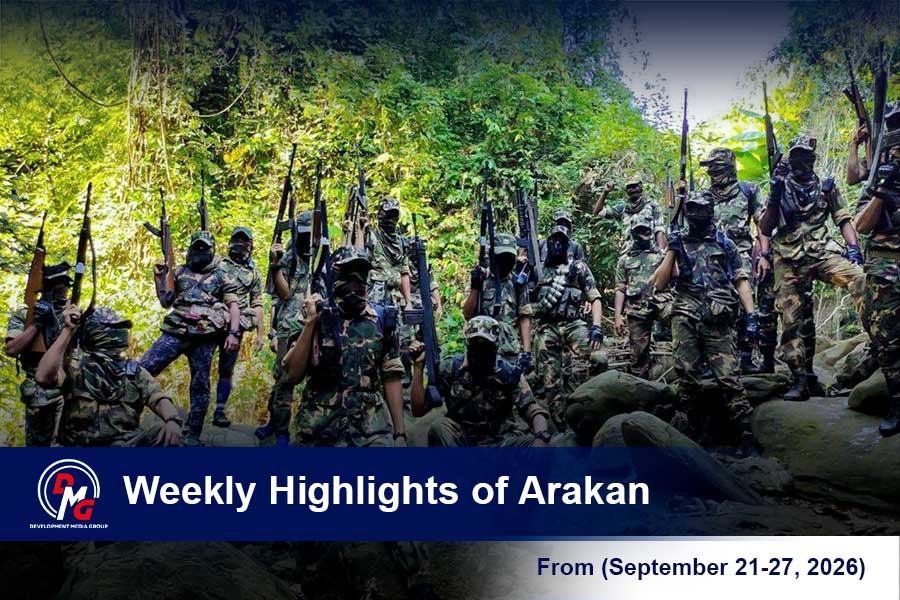
In an era when daily news from Arakan is often fragmented and fast-changing, DMG's Weekly Highlights of Arakan brings clarity, depth, and context to the stories that matter most.
Each week, we round up key political, military, social, and humanitarian developments across Arakan State - connecting the dots between events and offering analysis to help audiences see the bigger picture.
This series is designed for readers and viewers seeking a concise yet comprehensive understanding of how ongoing conflict, governance shifts, and community issues continue to shape lives across Arakan.
Six civilians killed, 16 injured in Arakan attacks over 11 days: AA
At least six civilians were killed and 16 others injured in a series of Myanmar military airstrikes and artillery attacks across Arakan State between September 17 and 27, according to a statement released by the Arakan Army (AA) on September 27.
The attacks affected several townships, including Ann, Minbya, Gwa, Kyauktaw, Ponnagyun, Pauktaw, Rathedaung, Thandwe and Mrauk-U, with civilian homes, religious buildings and a school also damaged, the AA said.
The following morning, two fighter jets bombed an area near a school in Taungphu village, damaging school buildings, the AA said.
The AA also reported that four fighter jets bombed former military positions in Mrauk-U on September 17, but no civilian casualties were reported in that attack.
The AA accused the military of repeatedly attacking schools, religious buildings, medical facilities, displacement sites and civilian-populated areas across Arakan. DMG could not independently verify all of the incidents and casualty figures in the AA statement.
According to the incidents detailed by the AA, six civilians were killed and 16 injured between September 17 and 27, while dozens of homes and several religious and educational buildings were damaged.
Ponnagyun residents displaced by fighting urgently need humanitarian aid
Fierce clashes between the military regime and the Arakan Army along the Sittwe-Ponnagyun border have forced residents of nearby villages to flee their homes, leaving them in urgent need of humanitarian aid, according to local sources.
To escape junta artillery strikes and air attacks, residents fled Yarchaung, Kuntaung, Padetha, Hsin Inn Gyi, Chaungwa, Kyunchay, Ahtokethel, and Dabethlyan villages in Ponnagyun Township.
Most displaced villagers are currently sheltering under tree canopies and in open areas, facing severe food shortages, according to displaced residents.
Many displaced people are suffering from seasonal illnesses and lack the financial means to access medical treatment.
Displaced families also expressed deep anxiety over shelter arrangements amid persistent threats of junta airstrikes.
The military regime launched a large-scale offensive targeting villages along the Ponnagyun border on September 4, but counterattacks by the Arakan Army forced junta troops to retreat.
Heavy fighting continues along the Sittwe-Ponnagyun border. Frequent junta airstrikes targeting areas across Ponnagyun Township continue to cause civilian casualties.
Junta naval attacks disrupt livelihoods in Werathani
Shelling, arbitrary detentions, and aggressive troop movements by junta navy warships in Werathani Township, Arakan State, have left local residents and displaced civilians struggling with severe livelihood and survival hardships, according to local sources.
In recent days, junta navy warships opened heavy artillery fire on two fishing boats near Anauk Phayonekar Island and surrounding areas in Werathani Township, while also firing heavy and light weapons toward nearby coastal villages, local residents reported.
These attacks and harassment by junta naval forces have created profound daily survival challenges for residents across Werathani Township.
Locals depend primarily on fishing for their livelihoods and rely on waterway transport for travel. The naval presence has severely restricted movement and maritime activities.
Displaced persons taking refuge on the island receive no humanitarian aid. Because junta warships shoot at and detain local fishermen, displaced families are barred from going out to sea, leaving them without daily income or food.
Hsintetmaw Village in Werathani Township shelters more than 100 displaced households comprising over 400 individuals.
Among them, more than 20 households face dire living conditions and require urgent relief assistance, according to local reports.
Regime deploys nearly 100 police personnel to Sittwe amid intense fighting
The military regime has deployed nearly 100 additional police personnel to Sittwe, the last remaining junta-controlled city in northern Arakan State, as fighting intensifies along the township's borders, according to local sources.
Junta naval vessels transported approximately 100 police officers and their family members to Sittwe on September 23, distributing them among police stations and battalions throughout the Arakan State capital.
Local residents suspect the regime brought in fresh police forces under the guise of urban security while intending to deploy them alongside military units in frontline defensive positions.
Sittwe currently hosts two main police stations and two security police battalions.
The No. 1 Myoma Police Station on Main Road and the No. 2 Police Station in Ywagyi Mrauk Ward serve as primary centers where regime forces arbitrarily detain local residents under the pretext of overnight guest registration inspections.
Additionally, two police battalions operate alongside military units for defence and military preparations in Sittwe.
The No. 12 Police Battalion, headquartered in Setyonesu Ward, actively provides heavy artillery support during ongoing clashes, according to local residents.
The No. 36 Police Battalion, located west of Sittwe University in Bumay Village near Sittwe Airport, remains a critical strategic installation for military regime forces.
Heavy clashes between the military regime and the Arakan Army continue to rage along the Sittwe-Ponnagyun border, with artillery shells landing inside Sittwe.
Relentless artillery detonations and heavy gunfire have left Sittwe residents living in constant fear for their safety.
With the military regime maintaining a strict land and water blockade around Sittwe, commercial air travel remains the sole exit route from the city.
Surging inflation and widespread unemployment are forcing daily wage earners to struggle for basic survival while neglecting urgent healthcare needs.
Facing severe food shortages, medical crises, and security threats, local residents in Sittwe require immediate humanitarian assistance.
AA clashes with ARSA in northern Maungdaw
Fighting erupted between the Arakan Rohingya Salvation Army (ARSA) and the Arakan Army (AA) near Milepost 56 in northern Maungdaw Township, Arakan State, according to local ground sources.
The engagement began at around 8:00 p.m. yesterday when ARSA members attacked an Arakan Army outpost, according to a military source.
DMG is continuing to investigate further details about the situation on the ground.
Military sources and analysts have previously reported that armed groups including ARSA, the Arakan Rohingya Army (ARA), and the Rohingya Solidarity Organization (RSO) have crossed into Arakan State from the Bangladesh border and carried out attacks on Arakan Army positions. They have also been accused of ambushes, killings of local residents, and kidnappings for ransom.
Military analysts say ARSA periodically resumes offensive activities after periods of relative calm, suggesting that attacks against Arakan Army positions in Maungdaw could be linked to ongoing fighting in Sittwe Township.
To counter threats posed by armed groups in Maungdaw District, the Arakan Army imposed a nighttime curfew from 10:00 p.m. to 4:00 a.m. effective August 9, alongside heightened security operations.
Amid ongoing fighting in Sittwe Township, reports of ARSA movements in the Mayu Mountain Range have also prompted local communities to organize rotating night patrols to protect village security.
India-Arakan trade route reopens after eight-day closure
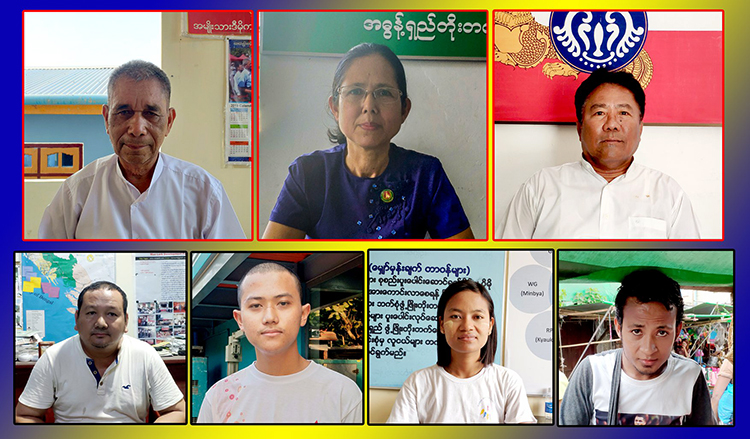
The India-Arakan trade route, which was temporarily closed following a dispute at Khaikhy Gate, reopened on September 24, according to a statement released by the Mara Thyutlia Py (MTP).
Transit along the trade corridor was suspended on September 16 following a verbal dispute between local youths and Arakanese merchants at Khaikhy Gate on September 14.
The trade route reopened on the evening of September 24 after representatives of the Mara Thyutlia Py and Arakan Army held discussions.
Regarding the Khaikhy incident, the MTP statement said both sides had resolved their misunderstandings and differences through peaceful dialogue. The discussions also addressed future cooperation between the Arakanese and Mara peoples, peaceful coexistence, and the flow of regional trade.
The India-Arakan trade corridor serves as a vital lifeline for Arakan State, which remains under a severe military regime blockade. However, frequent disruptions along the route continue to affect local communities.
The corridor is crucial not only for maintaining regional food and commodity supplies but also for hundreds of local workers, including cargo boat operators and stevedores, whose livelihoods depend entirely on cross-border trade.
During the closure, boat operators and stevedores faced severe livelihood hardships.
Earlier this year, on February 12, the trade route was temporarily closed for a week after an Indian driver delivering goods was killed in Shinletwa Village, triggering fluctuations in local commodity prices.
Merchants emphasized that because the trade corridor remains the sole lifeline for the Arakanese public, all parties must make every effort to prevent future disruptions.

Opinion

Arakan Army’s Gains and the Changing Geopolitics of Arakan
By Admin 29 Sep 2026

Beyond Military Victory: What Is Myanmar’s Ultimate Political Objective?
By Admin 26 Sep 2026
UN at a Crossroads: Six Priorities for a Shared Future
By Admin 23 Sep 2026
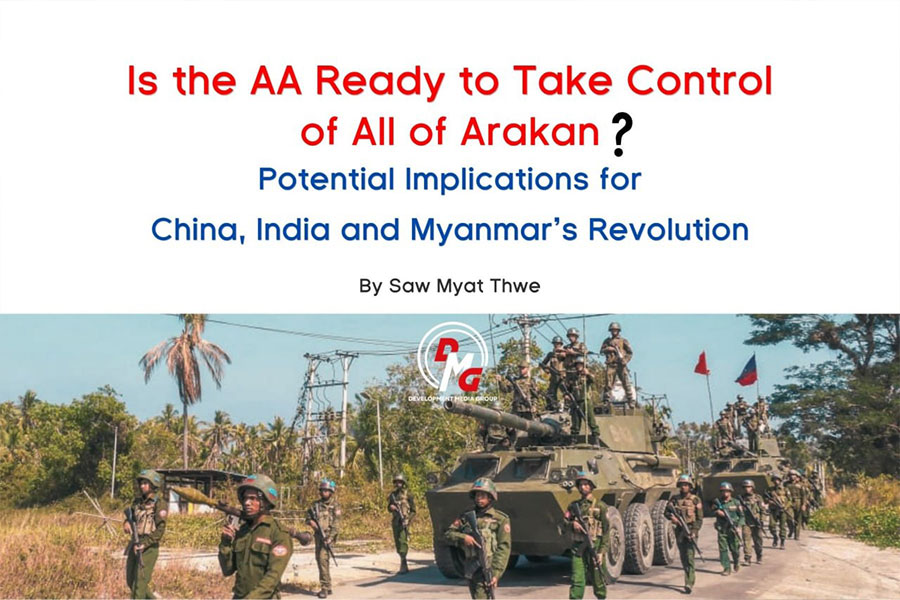
.jpg)
How Can Myanmar’s Political Crisis Be Brought to an End?
By Admin 13 Sep 2026

By Cutting Trees, We Are Killing Ourselves
By Admin 06 Sep 2026
POLITICS

BUSINESS
Industry to manufacture finished goods from coconut starting in early 2020
By Aung Kaung Zaw 20 Nov 2019