
- Malaria cases surge across Ann Twsp as residents struggle to access healthcare
- Arakan’s elderly face deepening crisis amid war: CAS study
- ULA detains Arakanese merchants over Khaikhy dispute, moves to resolve issue
- Arakan Army captures four junta outposts on Sittwe-Ponnagyun front
- Magway records most airstrikes since new military chief took command: ISP-Myanmar
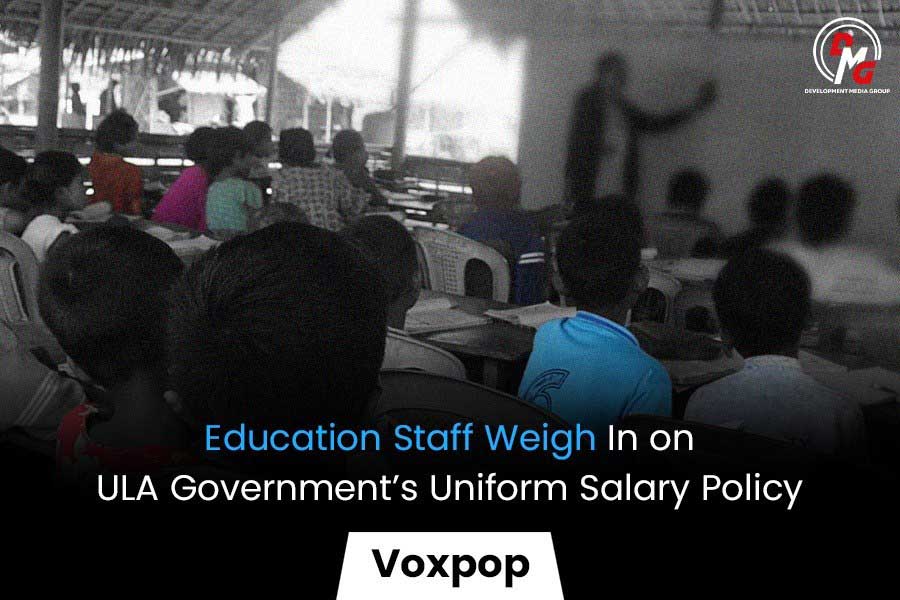
Vox Pop: Education Staff Weigh In on ULA Government’s Uniform Salary Policy
Against this backdrop, DMG spoke with education staff from several townships to hear their views on the ULA government’s decision to set a uniform monthly salary of 200,000 kyats.
18 Sep 2026
DMG Newsroom
18 September 2026, Rathedaung
The ULA government is operating the education sector more systematically this year, including managing personnel and setting salary rates as part of its efforts to develop the education system.
Unlike last year, the monthly salary for education staff has reportedly been set at a uniform rate of 200,000 kyats for all staff.
However, with commodity prices soaring across Arakan, many people are struggling to meet their basic living expenses and facing difficulties covering other essential needs, including healthcare and education.
Against this backdrop, DMG spoke with education staff from several townships to hear their views on the ULA government’s decision to set a uniform monthly salary of 200,000 kyats.
High School Teacher, Rathedaung Township
“I think it is good that the ULA has set a uniform salary for teachers. But I also think the individual circumstances and needs of teachers should be taken into consideration.
“Some teachers have to travel from far away to teach. Because transportation is difficult, some have to stay in rural villages where they are assigned to teach. For those teachers, there is no way they can manage on a salary of 200,000 kyats while living and teaching away from home.
“For those of us who are from the village where we teach, we can manage our basic living expenses to some extent. But if we get sick or face a health problem, that amount is nowhere near enough.
“That’s why I think teachers who come from distant areas should receive additional allowances. That would provide them with greater financial security.”
Primary School Teacher, Anjanapura (Minbya) Township
“There is no way 200,000 kyats is enough under the current circumstances. Commodity prices are rising, and we can spend around 30,000 kyats a day just on food and snacks.
“For those with children, there are also education expenses, books and snacks for their children. There is simply no way a monthly salary of 200,000 kyats can cover all of that.
“In my case, the school where I teach is far from my home. I have a young child, so it is difficult for me to stay in a rural area while teaching there. But if I commute, I have to pay travel expenses.
“If I stay where I teach, I also have to pay rent and living expenses, so 200,000 kyats is still nowhere near enough. That’s why I would like teachers who travel from distant areas to receive additional support, whether for fuel or other travel expenses.”
Primary School Teacher, Kyauktaw Township
“The government said a schoolteacher would receive a monthly salary of 200,000 kyats. But in reality, I receive only a little over 100,000 kyats a month. That makes things very difficult.
“I also have to travel to another area to teach. It is too far to commute there and back every day, so I have to stay in the village where I teach. Even if I regularly received the full 200,000 kyats, it still wouldn’t be enough.
“At a time when commodity prices and the cost of almost everything are rising, we are not even receiving the full salary that was set, and we have to cover some expenses out of our own pockets.
“For teachers with children and families, it is extremely difficult. That’s why I think the decision to set teachers’ salaries at 200,000 kyats a month should be reconsidered.”
Middle School Principal, Werathani (Pauktaw) Township
“What I want to say about the uniform salary is that there are veteran teachers who have served for many years, while there are also teachers who have recently joined as volunteers. When both are paid the same salary, I think consideration should be given to how those veteran teachers might feel.
“I would like salaries to be set according to position. I would also like the current salary policy to be reviewed.
“As everyone knows, 200,000 kyats is simply not enough to cover basic living expenses. It is even more difficult for staff who are married and have families. A salary of 200,000 kyats can be gone before half the month is over just on food and daily expenses, and that doesn’t even include healthcare costs.
“As education staff, we don’t have much time to do other work to earn additional income, so we have to depend on our salaries. Given the current cost of living, I would like the salary rate to be reviewed and increased to a level that allows staff to meet their basic needs.”
Female School Principal (Primary School In-Charge), Kyauktaw Township
“In my case, if I travel to and from the school by motorcycle in one day, I use about one litre of petrol. The road is also bad, and I have to walk for about half an hour to reach the school.
“It isn’t easy to make the round trip every day. But if I stay there while teaching, a salary of 200,000 kyats is nowhere near enough to cover my family’s living expenses, healthcare and education costs.
“It also costs me around 50,000 kyats just to travel to the place where I collect my salary. That’s why I would like teachers who have to travel long distances to receive travel allowances.
“At the moment, whether someone is a high school teacher or a volunteer teacher from the village, the salary is the same. Teachers who live in the village where they teach don’t have to spend money on travel because they can stay in their own village and teach there.
“But teachers who come from other areas have additional travel expenses. That’s why I would like teachers who have to travel from other areas to receive additional pay.”

Opinion
.jpg)
How Can Myanmar’s Political Crisis Be Brought to an End?
By Admin 13 Sep 2026
By Cutting Trees, We Are Killing Ourselves
By Admin 06 Sep 2026
A Modern August We Must Never Forget
By Admin 31 Aug 2026
Arakan’s Political Shifts and the Debate Over Rights and Governance
By Admin 27 Aug 2026
Securing Rights for Bangladesh's Indigenous Peoples is Indispensable
By Admin 09 Aug 2026

POLITICS

BUSINESS
Industry to manufacture finished goods from coconut starting in early 2020
By Aung Kaung Zaw 20 Nov 2019