

- Magway records most airstrikes since new military chief took command: ISP-Myanmar
- Junta warship destroys two fishing boats, seizes another off Werathani
- Junta jet fighters drop 500-pound bombs on former junta battalions in Mrauk-U
- Junta deploys fighter jets to bomb Ponnagyun
- Rathedaung villagers set up night watches amid Sittwe clashes, ARSA threat
Sino-Indian rivalry deepens as junta seeks backing from Beijing and New Delhi
Myanmar's military junta is seeking support from both China and India as the two regional powers compete for strategic influence and access to the Indian Ocean through Myanmar, analysts said on Thursday.
18 Jun 2026
DMG Newsroom
18 June 2026, Mrauk U
Myanmar's military junta is seeking support from both China and India as the two regional powers compete for strategic influence and access to the Indian Ocean through Myanmar, analysts said on Thursday.
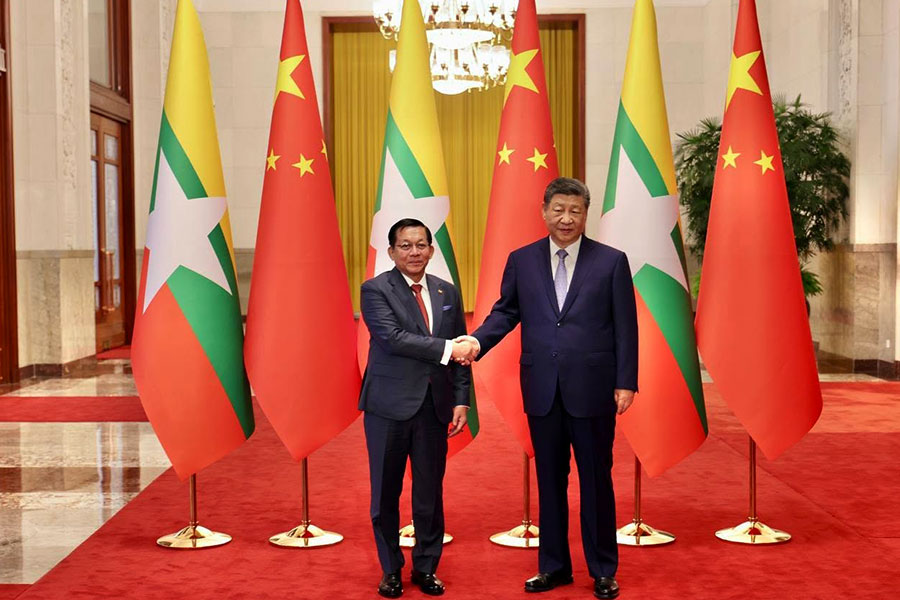
Following a military-organized election, self-appointed President Min Aung Hlaing recently completed a five-day visit to India and is currently on a four-day visit to China.
Political observers said the reception given to Min Aung Hlaing in Beijing could strengthen the junta's international standing despite ongoing criticism over its treatment of civilians and handling of the country's political crisis.
Analysts also expect China to increase pressure on resistance groups to halt military offensives and enter negotiations with the junta, particularly in northern Shan State.
According to junta-controlled media, self-appointed President Min Aung Hlaing told Chinese President Xi Jinping that the regime remains committed to implementing projects under the China-Myanmar Economic Corridor (CMEC), a major component of China's Belt and Road Initiative (BRI).
The corridor stretches from China's Yunnan Province through Mandalay and Yangon to the deep-sea port of Kyaukphyu in Arakan State.
"Myanmar remains the central pivot in a strategic trilateral dynamic," political analyst Dr. Sai Kyi Zin Soe said.
"India seeks to expand its economic and maritime influence through Myanmar, while China views the country as a vital route connecting it to the Indian Ocean and reducing its dependence on the Malacca Strait."
However, many of the areas linked to major infrastructure projects remain affected by armed conflict.
The Arakan Army is continuing operations around Sittwe and Kyaukphyu, while the junta is relying on airstrikes and artillery attacks to defend its remaining positions.
"Min Aung Hlaing's commitments in Beijing directly relate to Kyaukphyu, which remains an active conflict area," a local analyst monitoring Chinese investments in Arakan State said.
"Any future implementation of these projects will require engagement with the authorities that control territory on the ground."
India is also moving ahead with the Kaladan Multi Modal Transit Transport Project, which aims to connect India's northeastern states to the Bay of Bengal through Sittwe Port.
During his visit to India, self-appointed President Min Aung Hlaing and Indian Prime Minister Narendra Modi discussed cooperation on completing the Kaladan project by 2027 and advancing the India Myanmar Thailand Trilateral Highway.
The junta also signed 18 memorandums of understanding during Min Aung Hlaing's visit to China. The agreements cover border management, security cooperation, counter narcotics efforts, action against online scam operations and other bilateral initiatives. China also pledged assistance for the reconstruction of Aung San Stadium in Yangon.
Political analyst U Myo Kyaw said growing competition between China and India is driving both countries to strengthen their engagement with Myanmar.
"China and India have a long history of strategic competition," he said. "As India's demand for resources and regional connectivity grows, it is increasingly seeking to expand its influence in Myanmar, where China has traditionally maintained a strong presence."
The United League of Arakan and the Arakan Army now exercise control over most of Arakan State, including areas where several major foreign investment projects are located.
The ULA/AA has repeatedly stated that it welcomes foreign investment and has pledged to protect foreign assets and personnel. It has also called on investors to engage directly with local authorities in areas under its control.
Observers say the future of major Chinese and Indian projects in Arakan State will depend largely on developments on the ground and the ability of all stakeholders to engage with local authorities controlling the project areas.

Top News
Magway records most airstrikes since new military chief took command: ISP-Myanmar
By Admin 17 Sep 2026
Junta warship destroys two fishing boats, seizes another off Werathani
By Admin 17 Sep 2026
Junta jet fighters drop 500-pound bombs on former junta battalions in Mrauk-U
By Admin 17 Sep 2026
JFM calls for Myanmar military to be barred from ARF drone workshop
By Admin 17 Sep 2026
Junta deploys fighter jets to bomb Ponnagyun
By Admin 17 Sep 2026