

- Magway records most airstrikes since new military chief took command: ISP-Myanmar
- Junta warship destroys two fishing boats, seizes another off Werathani
- Junta jet fighters drop 500-pound bombs on former junta battalions in Mrauk-U
- Junta deploys fighter jets to bomb Ponnagyun
- Rathedaung villagers set up night watches amid Sittwe clashes, ARSA threat
China’s Kyaukphyu Push and the Reality of War in Arakan
Min Aung Hlaing’s China visit shows that the junta still seeks legitimacy through powerful neighbors. It also shows that China remains determined to protect its strategic interests in Myanmar, especially access to the Indian Ocean through Arakan.
23 Jun 2026
DMG | Special Analysis
Min Aung Hlaing’s recent visit to China has produced another round of high-level commitments between Beijing and Myanmar’s military junta, including an agreement to accelerate key China-Myanmar Economic Corridor (CMEC) projects such as the Kyaukphyu Deep-Sea Port and the Mandalay-Muse railway.
On paper, the agreement presents an image of renewed cooperation, infrastructure momentum, and strategic partnership. In reality, however, it exposes one of the central contradictions of Myanmar’s current crisis: the junta continues to sign major international agreements over territories it no longer fully controls.
This contradiction is most visible in Arakan State.
Kyaukphyu and China’s Strategic Calculation
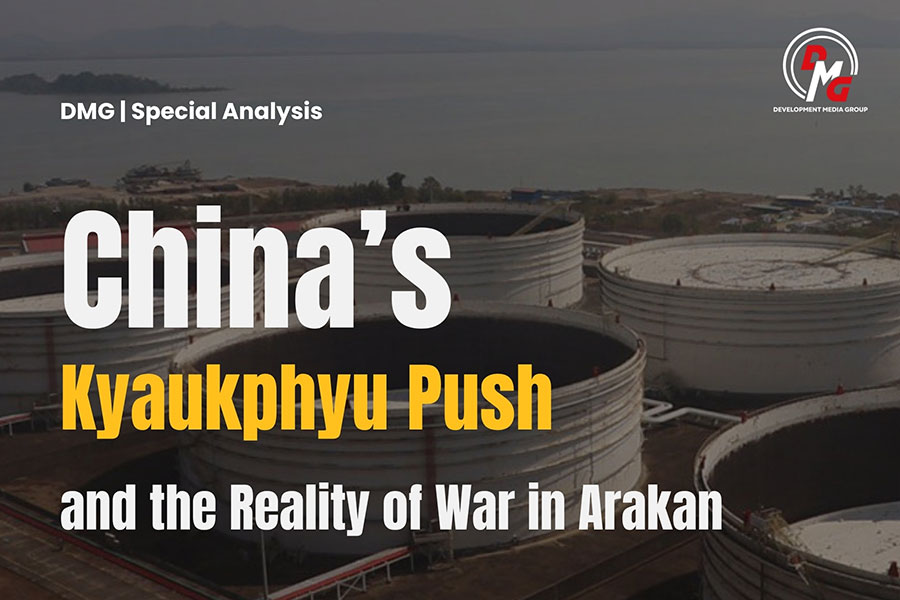
Kyaukphyu is not an ordinary development project. Located on Maday and Yarai Chaing islands, the Kyaukphyu Deep-Sea Port is a critical part of China’s long-term strategy to secure access to the Indian Ocean through Myanmar. Together with existing oil and gas pipelines, the port offers Beijing a route to the Bay of Bengal that reduces reliance on the Strait of Malacca.
The first phase of the project is expected to cost around US$1.3 billion. Under the existing arrangement, China’s state-owned CITIC Consortium holds a 70 percent stake, while Myanmar entities hold the remaining 30 percent.
During Min Aung Hlaing’s China visit, both sides reaffirmed their commitment to CMEC, the Belt and Road Initiative (BRI), cross-border electricity cooperation, oil and gas pipeline operations, agriculture, energy production, and bilateral trade. They also discussed direct settlement systems using the Chinese yuan and Myanmar kyat to facilitate border trade.
For China, these agreements are about strategic continuity. Beijing wants its infrastructure corridor to remain viable despite Myanmar’s internal conflict. For the junta, the agreements are about political survival. They provide diplomatic visibility, economic hope, and an image of international recognition at a time when the military is losing authority across large parts of the country.
But agreements signed in Beijing cannot erase the reality on the ground.
The Ground Reality in Arakan
Fighting continues in Kyaukphyu Township, where the Arakan Army (AA) is engaged in clashes with junta forces. Several areas linked to the Kyaukphyu project corridor are now under AA control or influence.
Across much of Arakan, the United League of Arakan/Arakan Army has become the dominant political, military, and administrative authority. The junta retains limited footholds, including Sittwe, Kyaukphyu, Manaung, and several military positions, but its broader ability to govern the state has sharply declined.
This means that any serious effort to implement Kyaukphyu or other major projects in Arakan cannot rely on the junta alone. Security, local acceptance, labor, transport routes, taxation, and community relations all increasingly depend on authorities operating on the ground.
China understands this reality, even if it does not state it publicly. Beijing may continue to formally engage Naypyidaw, but the practical future of Kyaukphyu will depend on whether China can navigate Arakan’s new balance of power.
Diplomacy Above, Bombs Below
The timing of the China-junta agreement is especially striking because it coincides with renewed civilian suffering in Arakan.
On June 17, junta fighter jets carried out airstrikes on Kyauktaw and its surrounding areas. According to the Arakan Army, at least eight civilians, including a four-year-old child, were killed and 19 others were injured. The airstrikes hit multiple civilian areas, including Paik Thei Ward, Ywarma Ward, Ka Ta 2 Road, the area between Roads 2 and 3, a temporary market, and Lanmadaw Village across the Kisapanadi River.
The attacks damaged homes, shops, a market area, civilian workplaces, and an ordination hall at a Buddhist monastery. Around 30 buildings were damaged or destroyed, according to initial assessments.
This is the painful contrast defining Abakan today: while the junta discusses ports, railways, pipelines, and trade corridors with China, its aircraft continue to bomb civilian communities.
For local people, the central question is not whether CMEC will advance or whether Kyaukphyu will attract foreign investment. The immediate question is whether they can survive another airstrike, access medicine, find food, educate their children, and rebuild homes destroyed by war.
Human Rights and Humanitarian Concerns
The Kyauktaw airstrikes are part of a broader pattern. As the junta loses ground in Arakan, it increasingly relies on airpower to strike areas outside its control. Markets, schools, hospitals, monasteries, detention sites, and residential neighborhoods have repeatedly come under attack over the past two years.
This pattern raises serious human rights and humanitarian concerns.
Civilian areas continue to face aerial bombardment. Displacement remains widespread. Healthcare systems are under pressure. Schools are disrupted. Livelihoods are collapsing due to insecurity, blocked transport routes, inflation, and damaged infrastructure.
In this environment, development projects cannot be separated from civilian protection. No infrastructure corridor can be considered sustainable if surrounding communities live under fear of airstrikes and displacement.
For China, this creates a strategic problem. A project like Kyaukphyu requires stability, but stability cannot be produced by diplomatic statements alone. It requires security, legitimacy, community consent, and protection of civilians.
What This Means for the Arakan Army
Min Aung Hlaing’s China visit may appear to strengthen the junta diplomatically, but it also highlights the growing importance of the AA.
If China wants Kyaukphyu to move forward, it must account for the AA’s expanding role. The AA has already indicated that it welcomes foreign investment that benefits Arakan and has called for direct cooperation on projects in areas under its control.
This gives the AA both leverage and responsibility.
Its leverage comes from territorial influence and administrative capacity. Its responsibility lies in ensuring that future development serves local communities, protects land rights, avoids environmental harm, and does not simply replace one form of centralized exploitation with another.
For Arakan, the question is not merely whether foreign investment comes. The more important question is who benefits from it.
A Wider Myanmar Pattern
The China visit also reflects a wider trend in Myanmar. The junta is trying to use foreign diplomacy to compensate for domestic military failure. After visiting India, Min Aung Hlaing turned to China, seeking support from two powerful neighbors whose interests converge in Myanmar’s borderlands and coastal corridors.
India wants the Kaladan Multi-Modal Transit Transport Project and access to its northeast through Arakan. China wants Kyaukphyu, CMEC, pipelines, and Indian Ocean access. Both powers want border stability and protection of strategic interests.
But both face the same reality: Myanmar is no longer governed from a single center.
Ethnic armed organizations and resistance forces now control or influence major territories. In Arakan, the AA has become an unavoidable actor. In northern Shan, Kachin, Chin, Sagaing, and other regions, the junta’s control is also contested.
This means regional powers can no longer treat Naypyidaw as the only address for Myanmar policy.
Development Without Peace Is Fragile
The agreement to speed up Kyaukphyu may look significant, but implementation will be far more difficult than announcement.
The project sits in a conflict-affected region. Transport corridors remain insecure. Local communities face humanitarian hardship. Political authority is fragmented. The junta lacks broad legitimacy. The AA controls or influences key areas. China must balance formal relations with Naypyidaw against practical realities on the ground.
Under these conditions, any development project that ignores local political realities risks deepening conflict rather than creating stability.
For Arakan people, development must mean more than ports, pipelines, and railways. It must include civilian safety, local participation, environmental protection, fair economic benefits, transparency, and accountability.
Without those elements, Kyaukphyu could become another symbol of external interests imposed on a conflict-affected region.
Conclusion
Min Aung Hlaing’s China visit shows that the junta still seeks legitimacy through powerful neighbors. It also shows that China remains determined to protect its strategic interests in Myanmar, especially access to the Indian Ocean through Arakan.
But the agreement to accelerate Kyaukphyu and CMEC projects does not change the basic reality: the junta no longer fully controls the territory where many of these projects are located.
Arakan is now shaped by two competing realities. On the diplomatic stage, the junta signs agreements with China. On the ground, the AA administers much of the state. In the skies, junta aircraft continue to bomb civilian communities.
This is the contradiction at the heart of Myanmar’s current crisis.
If China wants genuine stability for Kyaukphyu, it cannot rely only on agreements with a weakened military regime. If the junta believes foreign partnerships can restore its authority, it is ignoring the political transformation already underway. And if development is to benefit Arakan, the voices and security of local people must be placed at the center.
The future of Kyaukphyu will not be decided only in Beijing or Naypyidaw. It will also be decided in Arakan, where war, governance, and geopolitics now meet.

Opinion
.jpg)
How Can Myanmar’s Political Crisis Be Brought to an End?
By Admin 13 Sep 2026

By Cutting Trees, We Are Killing Ourselves
By Admin 06 Sep 2026

A Modern August We Must Never Forget
By Admin 31 Aug 2026
Arakan’s Political Shifts and the Debate Over Rights and Governance
By Admin 27 Aug 2026
Securing Rights for Bangladesh's Indigenous Peoples is Indispensable
By Admin 09 Aug 2026

POLITICS


BUSINESS
Industry to manufacture finished goods from coconut starting in early 2020
By Aung Kaung Zaw 20 Nov 2019