

- Ponnagyun residents displaced by fighting urgently need humanitarian aid
- POW says junta soldiers offered cash, promotions and drugs before combat in Arakan
- Arakan Army blocks junta offensive on key route into Arakan State
- Junta airstrikes on Ponnagyun Twsp village kill two civilians
- Elderly residents at Kyaukphyu’s Thandar Myay Home for the Aged face food, medicine shortages
Buthidaung residents urge ULA to expand Starlink access amid telecom blockade
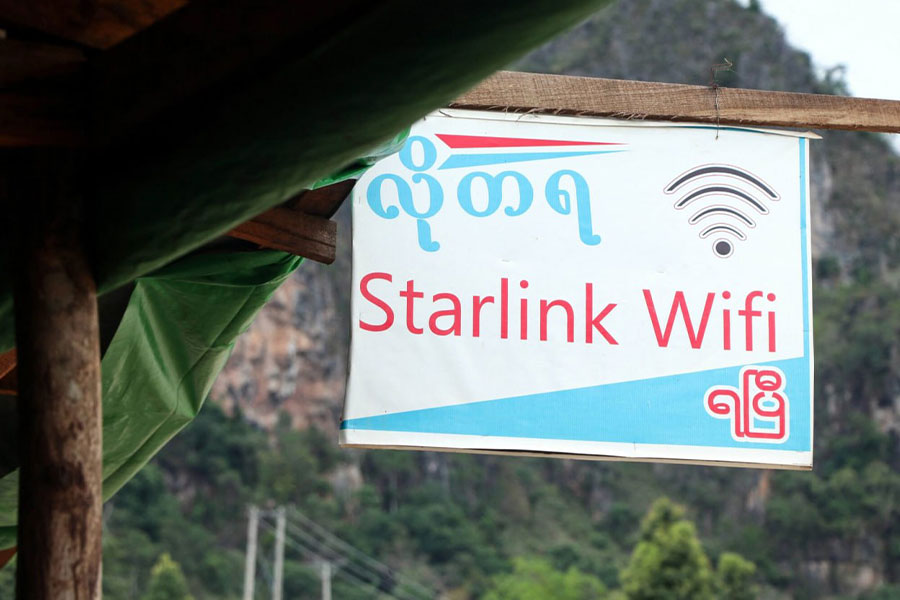
Residents in Myanmar's western Buthidaung Township are urging the United League of Arakan (ULA) to expand public Starlink satellite internet services and simplify registration procedures for privately owned systems amid an ongoing telecommunications blockade, local sources said Wednesday.
24 Jun 2026
DMG Newsroom
24 June 2026, Buthidaung
Residents in Myanmar's western Buthidaung Township are urging the United League of Arakan (ULA) to expand public Starlink satellite internet services and simplify registration procedures for privately owned systems amid an ongoing telecommunications blockade, local sources said Wednesday.
The ULA has issued operating licences for public Starlink installations across conflict-affected areas of Arakan State to address widespread mobile network and internet disruptions.
However, residents said limited infrastructure in Buthidaung has left many communities without reliable access.
"Local entrepreneurs have repeatedly submitted proposals to the ULA administration to establish commercial Starlink connectivity hubs, but these requests remain delayed due to security considerations," a local male resident said. "People currently have to travel to the few available terminals, spending between K50,000 and K60,000 on transportation costs alone, while connection speeds remain unstable."
The ongoing conflict and communication restrictions have severely affected digital access across the township. While some neighbouring areas under ULA administration have wider connectivity networks, Buthidaung continues to face limitations due to security restrictions.
"Other ULA-controlled areas have better access to internet services," the resident added. "We urgently want the administration to allow more satellite internet hubs in accessible civilian areas across Buthidaung."
Buthidaung's location near the Bangladesh border has further complicated communication challenges.
Currently, only two public Starlink terminals are operating across the township. Local sources said the arrival of the monsoon season has made travel more difficult, increasing costs for residents who need internet access for essential communications.
Some border communities have attempted to bypass domestic telecom restrictions by using makeshift cellular towers connected to Bangladeshi SIM cards. However, residents said the service is expensive, costing up to K1,000 per minute.
"In neighbouring Maungdaw Township, Bangladeshi mobile signals cover around 60 percent of the area, forcing some Buthidaung residents to travel there for urgent communication needs," another local source said.
"Heavy monsoon rains are now disrupting these routes and affecting even basic mobile access. Expanding local internet hubs is necessary to support social and economic activities," the source added.
The ULA Technical Department previously approved registered Starlink satellite operations to support humanitarian coordination, business activities, public safety, and independent media work while maintaining security measures.
Although Starlink services have expanded across many ULA-administered areas, Buthidaung remains underserved.
An official from the ULA Technical Department said security risks and frequent junta airstrikes require strict oversight of satellite internet networks.
The official added that regulated access is necessary to prevent the disclosure of sensitive military information and reduce risks to civilian areas from aerial attacks.
The department confirmed that privately owned Starlink systems are allowed, but residents in sensitive areas must obtain verification and approval from relevant military and security authorities before installation.

Top News
Ponnagyun residents displaced by fighting urgently need humanitarian aid
By Admin 23 Sep 2026
POW says junta soldiers offered cash, promotions and drugs before combat in Arakan
By Admin 23 Sep 2026
Arakan Army blocks junta offensive on key route into Arakan State
By Admin 23 Sep 2026
Junta airstrikes on Ponnagyun Twsp village kill two civilians
By Admin 23 Sep 2026
Two men arrested in Gwa Twsp over alleged sexual assault of three-year-old child
By Admin 22 Sep 2026


.jpg)