
- Magway records most airstrikes since new military chief took command: ISP-Myanmar
- Junta warship destroys two fishing boats, seizes another off Werathani
- Junta jet fighters drop 500-pound bombs on former junta battalions in Mrauk-U
- Junta deploys fighter jets to bomb Ponnagyun
- Rathedaung villagers set up night watches amid Sittwe clashes, ARSA threat
Analysts warn Min Aung Hlaing’s India trip could affect Myanmar revolution
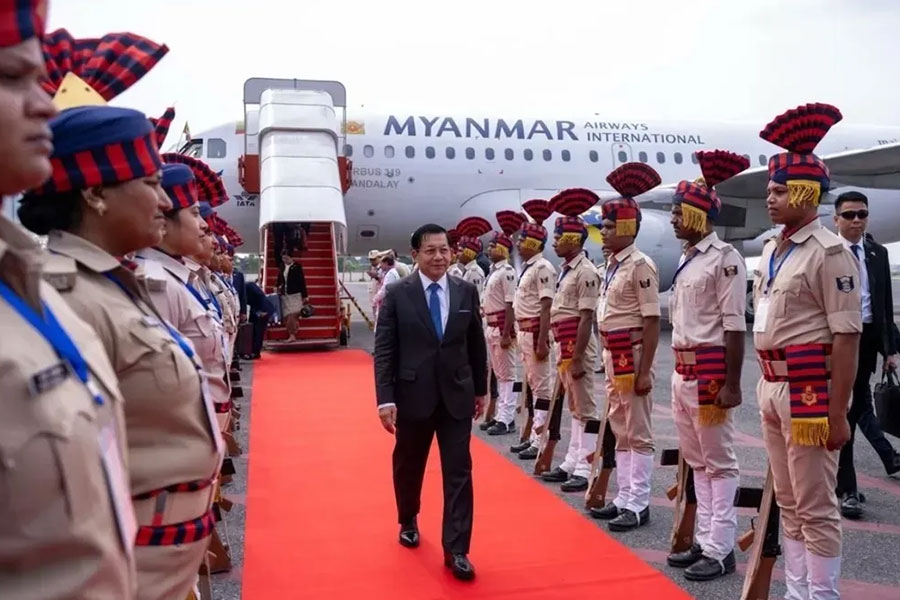
Junta-chief-turned President Min Aung Hlaing, who became president following the 2025 election, is currently in India for his first foreign trip since taking office.
02 Jun 2026
DMG Newsroom
2 June 2026, Mrauk-U
Junta-chief-turned President Min Aung Hlaing, who became president following the 2025 election, is currently in India for his first foreign trip since taking office.
Political and military analysts say Min Aung Hlaing’s visit to India could have implications for Myanmar’s revolution and political landscape.
The Indian government announced that former military chief Min Aung Hlaing met with Indian Prime Minister Narendra Modi on 1 June, with discussions focusing primarily on Myanmar’s current political situation.
Political analysts said that during the trip, India could raise concerns about armed groups operating along the Indian border in Arakan, Chin and Kachin states, as well as Sagaing Region, similar to the pressure China exerted on ethnic armed organizations in northern Shan State.
“Min Aung Hlaing’s trip to India could impact Arakan State. This is because part of the Myanmar military’s recent strategy in eastern Myanmar, especially along the Chinese border in Shan State, involved negotiations aimed at squeezing and pressuring border-based revolutionary forces. They may try to adopt a similar model on the Western Front, especially at a time when they are retreating from Arakan State. They could collaborate with India to apply pressure on Arakan, Chin and Kachin states, as well as northern Sagaing. Therefore, there could be some degree of impact,” political analyst U Myo Kyaw said.
The Indian government recognizes and supports the junta-organized election and has continuously provided the Myanmar military with weapons and technical assistance.
Military analysts said Min Aung Hlaing’s trip could create difficulties for ethnic armed organizations and revolutionary forces operating along the Indian border.
Captain Zin Yaw, a participant in the Civil Disobedience Movement, said: “Direct closures like the situation along the Chinese border might not happen. However, opportunities for revolutionary forces to operate along the border area could become tighter and more restricted. Min Aung Hlaing’s trip will bring no benefit to the revolutionary forces. I estimate there will only be limitations and restrictions.”
Revolutionary forces fighting against military rule along the Indian border include the Arakan Army (AA), Chin revolutionary forces, resistance groups under the National Unity Government (NUG) in Sagaing Region, the Kachin Independence Army (KIA), and other Naga ethnic forces.
Although the Indian government may not currently be able to provide direct military assistance to the Myanmar military, it could increase intelligence sharing, Captain Zin Yaw added.
“Chin, Arakan and Kachin states and Sagaing Region are areas where revolutionary forces opposing the regime are strong. Since India prioritizes border stability, the situation points toward increased information sharing and border control cooperation with the Myanmar military. If this happens, some of the freedom of movement enjoyed by revolutionary forces on the Indian side could decrease. Direct military assistance from India is not yet possible under the current situation,” he said.
Analysts noted that the Indian government has previously cooperated with the Myanmar military in operations targeting Arakanese revolutionary leaders and in launching attacks from the Naga region, meaning Myanmar’s revolutionary forces must exercise caution in dealing with India.
During the trip, India and the regime agreed to cooperate closely on finalizing the Kaladan Multi-Modal Transit Transport Project and the India-Myanmar-Thailand Trilateral Highway.
However, the Indian government’s Kaladan project in Arakan State is currently controlled by the Arakan Army, while rare earth mining areas in Kachin State are controlled by the KIA.
Another Arakanese political analyst said that because Chin State is strategically important, India is unlikely to completely block the flow of goods, though it may restrict military movements.
“There is no doubt that India supports the Myanmar regime. However, it is unlikely to cut off border trade. This is because major projects like the Kaladan project, as well as resources such as rare earth minerals, are in the hands of ethnic armed organizations, so the Indian government will not impose a total ban. However, there could be restrictions on military operations along the border,” an observer of India-Myanmar relations said.
Since the military coup, regions such as Arakan and Chin states, as well as Sagaing Region, have relied on trade from India for food supplies and some medicines.
Although the Indian government publicly engages with the Myanmar regime, it also maintains contact with ethnic armed organizations through governments in its border states.
Political analysts said that during the India trip, Min Aung Hlaing invited Indian businesspeople to invest in Myanmar, but such investments are unlikely to benefit the people of Myanmar.
Min Aung Hlaing is currently on a five-day visit to India from 30 May to 3 June at the invitation of the Indian government.

Top News
Magway records most airstrikes since new military chief took command: ISP-Myanmar
By Admin 17 Sep 2026
Junta warship destroys two fishing boats, seizes another off Werathani
By Admin 17 Sep 2026
Junta jet fighters drop 500-pound bombs on former junta battalions in Mrauk-U
By Admin 17 Sep 2026
JFM calls for Myanmar military to be barred from ARF drone workshop
By Admin 17 Sep 2026
Junta deploys fighter jets to bomb Ponnagyun
By Admin 17 Sep 2026

.jpg)