
- Military operations spread despite decline in clashes, BNI report finds
- Junta aerial attacks force school closures across three Arakan townships
- Family demands swift arrest of statutory rape suspect in Werathani
- Women face shrinking employment opportunities in Myanmar, UNDP reports
- AA seizes five junta outposts as Arakan records most civilian-targeted airstrikes: NLTA
Military operations spread despite decline in clashes, BNI report finds
Although the total number of armed clashes across Myanmar has declined compared with previous years, military operations and conflict zones are expanding significantly, according to an analytical report by BNI - Myanmar Peace Monitor.
17 Oct 2026
DMG Newsroom
17 October 2026, Mrauk-U
Although the total number of armed clashes across Myanmar has declined compared with previous years, military operations and conflict zones are expanding significantly, according to an analytical report by BNI - Myanmar Peace Monitor.
The findings were published in a report titled Deciphering Myanmar’s Peace Process: A Reference Guide (2025–2026).
Nationwide, a total of 1,854 clashes were recorded between 2025 and July 2026.
“Under current conditions, we cannot analyze the situation as 100 percent politically oriented,” said Ko Hnin Ko Oo, in charge of BNI - Myanmar Peace Monitor. “Military dynamics remain active. Currently, military intensity is high in Kachin and Arakan states. To reactivate military momentum in other regions, resistance forces are moving away from single group operations toward unified, collective actions.”
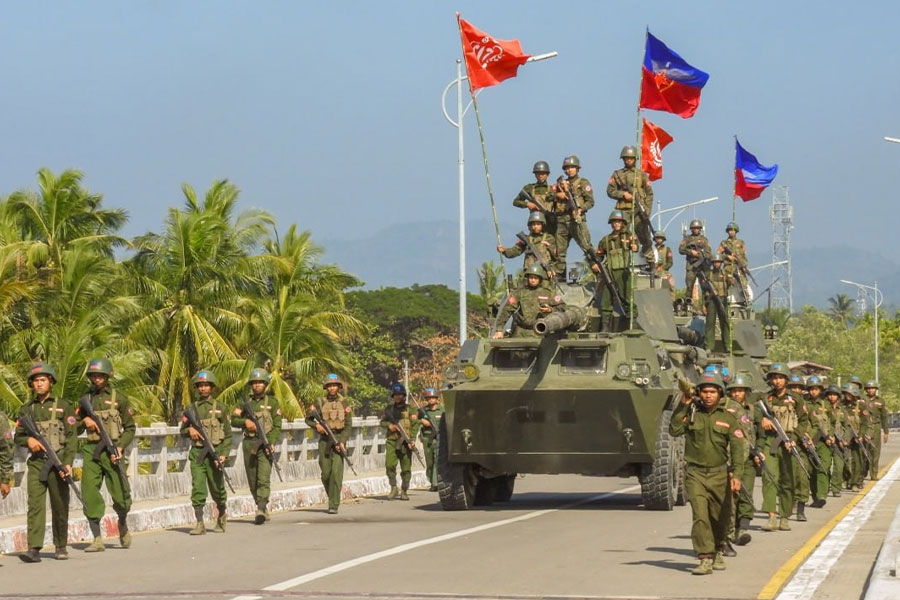
The report noted that clashes between the military junta and People’s Defence Forces (PDFs) outnumbered those fought directly between the military and Ethnic Resistance Organizations (EROs).
Clashes were concentrated mainly in Sagaing, Mandalay and Magway regions and the Anyar region, alongside ongoing fighting in Kachin and Arakan states, as well as areas where the Arakan Army (AA) operates.
“Rather than a reduction in military momentum, conflict has shifted location,” Ko Hnin Ko Oo added. “The main driver escalating conflict is the junta’s ongoing airstrikes. While conflict incidents in Arakan State temporarily dipped during a certain period, active military operations have increasingly spilled into surrounding border zones, including Bago, Ayeyarwady and Magway regions, and Chin State.”
Similarly, intense clashes between the military and EROs continue to center on major cities in northern and western Myanmar.
According to the BNI - Myanmar Peace Monitor report, widespread military conflict has undermined prospects for peace, threatening to prolong the war.
BNI assessed that forced military conscription imposed by the junta from 2026 onward would make the conflict difficult to end, pushing Myanmar into a prolonged period of war in the coming years.
Data from the BNI - Myanmar Peace Monitor report indicate that between January 2024 and July 2026, the military carried out 2,449 airstrikes, nearly 70 percent of which deliberately targeted civilians.
“The junta is losing militarily across the entire country, yet those at the top refuse to step down,” said Arakanese politician and writer Wai Hun Aung. “When they cannot defeat revolutionary forces on the battlefield, they carry out aerial bombardments on civilians to exert pressure and instill fear. Frankly, these continuous airstrikes against civilians are pure atrocities.”
In the 19 months between January 2025 and July 2026, there were 197 mass casualty incidents nationwide involving five or more civilian fatalities, claiming 2,123 civilian lives, according to the report.
Furthermore, between April 2022 and late July 2026, a total of 432 mass casualty events involving five or more deaths resulted in the deaths of 4,573 civilians.
Looking ahead to 2026 and beyond, BNI assessed that forced conscription and continued troop reinforcements by the military junta would make Myanmar’s conflict difficult to resolve, entrenching a prolonged war.

Top News
Military operations spread despite decline in clashes, BNI report finds
By Admin 17 Oct 2026
Junta aerial attacks force school closures across three Arakan townships
By Admin 17 Oct 2026

Family demands swift arrest of statutory rape suspect in Werathani
By Admin 17 Oct 2026
Women face shrinking employment opportunities in Myanmar, UNDP reports
By Admin 17 Oct 2026