

- Foreigners banned from renting homes in Lawngtlai
- Anjanapura child rape-murder case drags into second year without verdict
- War, conscription and unemployment threaten future of Arakan youth: study
- Vehicle shortages, weak information flow hamper relief operations in Arakan State
- Junta deploys naval vessels, steps up military operations in southern Arakan State
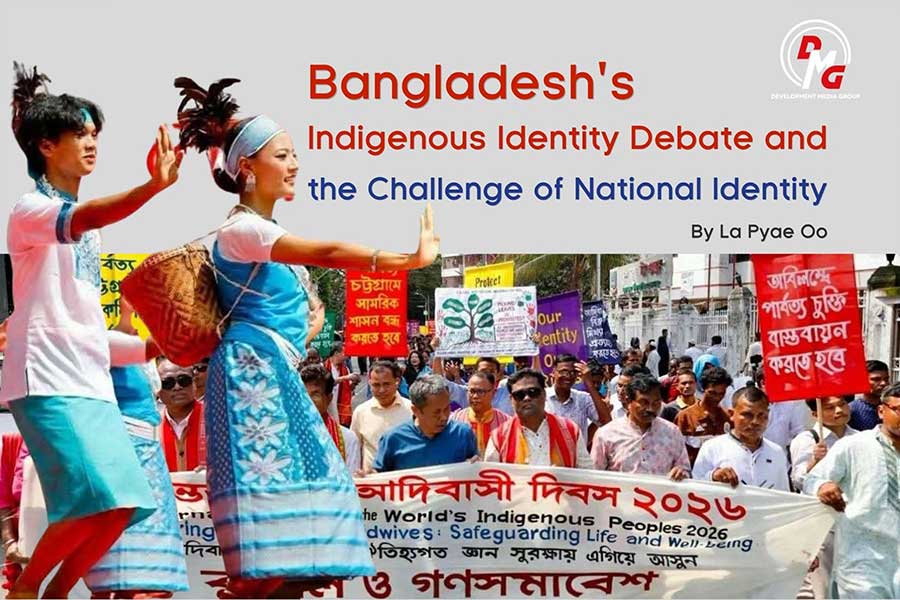
Bangladesh's Indigenous Identity Debate and the Challenge of National Identity
One of the defining challenges of nation-building in contemporary South Asia is balancing national unity with the recognition of the diverse ethnic identities that exist within a state's borders.
03 Sep 2026
By La Pyae Oo
One of the defining challenges of nation-building in contemporary South Asia is balancing national unity with the recognition of the diverse ethnic identities that exist within a state's borders.
Recent remarks by Bangladesh's Home Affairs Adviser Salahuddin Ahmed, who stated that "there are no separate Indigenous Peoples in Bangladesh; everyone is simply a Bangladeshi citizen," together with Information and Broadcasting Adviser Zahir Uddin Swapon's assertion that the term "Indigenous" is inappropriate in the Bangladeshi context, have reignited debate over the status of Indigenous communities in the Chittagong Hill Tracts (CHT) and broader questions of national identity.
The remarks prompted a strong response from the Chittagong Hill Tracts Commission (CHTC) and the International Work Group for Indigenous Affairs (IWGIA), which argued that denying Indigenous identity undermines the historical recognition, cultural rights and internationally recognized status of the Indigenous peoples of the CHT.
The controversy extends well beyond terminology. It reflects a broader political and constitutional debate over national identity, minority rights, state sovereignty and Bangladesh's obligations under international human rights standards. It also raises fundamental questions about how multiethnic societies can strengthen national cohesion while respecting cultural diversity and historical identity.
Historical Context: Nation-Building and Identity
Bangladesh's national identity was largely shaped by the Bengali nationalist movement that led to the country's independence in 1971. Language, culture and Bengali identity became the foundations of the new state.
At the same time, Bangladesh is home to numerous Indigenous and ethnic minority communities, particularly in the Chittagong Hill Tracts, including the Chakma, Marma, Tripura, Mro, Bawm and Khumi peoples. These communities possess distinct histories, languages, cultures and social institutions that long predate the establishment of the modern Bangladeshi state.
The Home Affairs Adviser argued that the concept of "Indigenous Peoples" primarily applies to countries such as the United States, Canada, Australia and New Zealand, where European settlers displaced original inhabitants, and therefore should not be applied to Bangladesh.
The CHTC and IWGIA reject this interpretation. They note that Indigenous Peoples live throughout Asia, Africa, the Pacific and the Arctic, and that international standards do not define Indigenous status solely by who arrived first. Rather, Indigenous identity is generally understood through a combination of self-identification, historical continuity, distinct cultural institutions and enduring relationships with ancestral lands.
The debate therefore reflects two competing understandings of national identity: one emphasizing a unified civic identity based on citizenship, and the other recognizing the coexistence of multiple historical identities within the same nation-state.
Constitutional and Legal Perspectives
The Bangladeshi government has emphasized that the country is not a signatory to either the United Nations Declaration on the Rights of Indigenous Peoples (UNDRIP) or ILO Convention No. 169.
However, the CHTC and IWGIA point out that Bangladesh remains a party to ILO Convention No. 107, which continues to impose legal obligations regarding Indigenous and tribal populations.
They further argue that Bangladesh's obligations under several international human rights treaties including the International Covenant on Civil and Political Rights (ICCPR), the International Covenant on Economic, Social and Cultural Rights (ICESCR), the Convention on the Rights of the Child (CRC), the Convention on the Elimination of All Forms of Discrimination against Women (CEDAW), the Convention on Biological Diversity (CBD) and the United Nations Framework Convention on Climate Change (UNFCCC) also require protection of Indigenous peoples' rights.
Domestically, Article 23A of Bangladesh's Constitution obliges the state to preserve and develop the unique cultures and traditions of ethnic communities. Critics therefore argue that denying the existence of Indigenous Peoples raises questions about whether the government's position is fully consistent with the Constitution's own recognition of cultural diversity.
While legal interpretations differ, the controversy illustrates the continuing tension between constitutional recognition of cultural diversity and the government's preference for a single national identity based on citizenship.
Sovereignty, Territorial Integrity and Political Concerns
From the government's perspective, formally recognizing Indigenous Peoples could create new claims relating to ancestral land ownership, self-determination and territorial rights under international law.
Given the Chittagong Hill Tracts' strategic location along Bangladesh's borders with Myanmar and India, Dhaka appears to view the issue not only through the lens of minority rights but also as one involving national security, territorial integrity and state sovereignty.
Officials have expressed concern that international recognition of Indigenous status could invite greater external involvement in domestic affairs or complicate longstanding disputes over land ownership and local administration.
By contrast, the CHTC and IWGIA argue that recognizing Indigenous identity neither undermines citizenship nor threatens Bangladesh's territorial integrity. Instead, they contend that recognition would strengthen trust between the state and minority communities while promoting social cohesion and democratic inclusion.
These competing perspectives highlight the broader dilemma facing many multiethnic states: how to protect national unity without diminishing the identities of historically distinct communities.
The Significance of the 1997 Chittagong Hill Tracts Peace Accord
A key reference point in the debate is the 1997 Chittagong Hill Tracts Peace Accord, signed between the Government of Bangladesh and the Parbatya Chattagram Jana Samhati Samiti (PCJSS).
According to the CHTC and IWGIA, the Accord implicitly recognizes the unique historical and political status of the Indigenous peoples of the Chittagong Hill Tracts. They argue that denying Indigenous identity today risks undermining both the spirit of the agreement and public confidence in the peace process.
Nearly three decades after the Accord was signed, implementation remains incomplete, and many of its political and administrative provisions continue to be debated. Consequently, renewed disagreement over Indigenous identity has revived broader questions regarding autonomy, governance, land rights and long-term conflict resolution in the region.
Social Implications and Civil Liberties
Beyond constitutional and political questions, the controversy carries important social implications.
The CHTC and IWGIA warn that portraying Indigenous rights advocacy as a threat to national sovereignty could increase pressure on Indigenous leaders, journalists, researchers and civil society organizations working on ethnic minority issues.
Such an environment could narrow civic space, discourage public discussion and make it more difficult to address longstanding grievances through peaceful dialogue.
The debate also affects how Indigenous communities perceive their place within the Bangladeshi state. For many members of these communities, recognition is closely linked to dignity, cultural preservation and equal participation in public life.
Conversely, policymakers who prioritize national unity fear that emphasizing ethnic distinctions could weaken a shared national identity.
Managing these competing concerns remains one of the country's most complex governance challenges.
Conclusion
The current debate in Bangladesh is not simply about choosing between national unity and ethnic diversity.
Rather, the central challenge is how to reconcile both within a constitutional framework that respects historical realities, cultural diversity and internationally recognized human rights principles.
The government's emphasis on a unified national identity reflects concerns about sovereignty, territorial integrity and political cohesion. Meanwhile, Indigenous organizations argue that recognition of Indigenous identity is compatible with citizenship and essential for protecting the rights, cultures and histories of minority communities.
Ultimately, Bangladesh's long-term stability and democratic development may depend less on terminology than on its ability to build an inclusive political framework in which all communities feel equally recognized, protected and represented.
Constructive dialogue between the government, Indigenous representatives, civil society organizations and other stakeholders will therefore be essential if Bangladesh is to reconcile national unity with respect for its rich ethnic diversity and achieve a more inclusive and sustainable political settlement.
The ongoing debate illustrates a broader challenge faced by many multiethnic democracies: ensuring that efforts to strengthen national unity do not come at the expense of cultural diversity, historical recognition or equal citizenship. Whether Bangladesh can successfully balance these competing priorities will shape not only the future of the Chittagong Hill Tracts but also the country's broader democratic and constitutional development.

Opinion

A Modern August We Must Never Forget
By Admin 31 Aug 2026
Arakan’s Political Shifts and the Debate Over Rights and Governance
By Admin 27 Aug 2026
Securing Rights for Bangladesh's Indigenous Peoples is Indispensable
By Admin 09 Aug 2026
Reflections on the Arakanese (Rakhine) Language Curriculum
By Admin 14 Jul 2026
Holding On to Arakan
By Admin 26 Jun 2026
POLITICS

BUSINESS

Industry to manufacture finished goods from coconut starting in early 2020
By Aung Kaung Zaw 20 Nov 2019