
- Thandwe locals flee homes again amid intense junta airstrikes
- ULA to recruit second batch of medical students amid doctor shortage
- Junta deploys hundreds of troops to Mindon for Arakan offensive
- ICRC expands humanitarian assistance as needs grow in Arakan and Myanmar
- Arakan Lottery ticket markups raise calls for stricter oversight
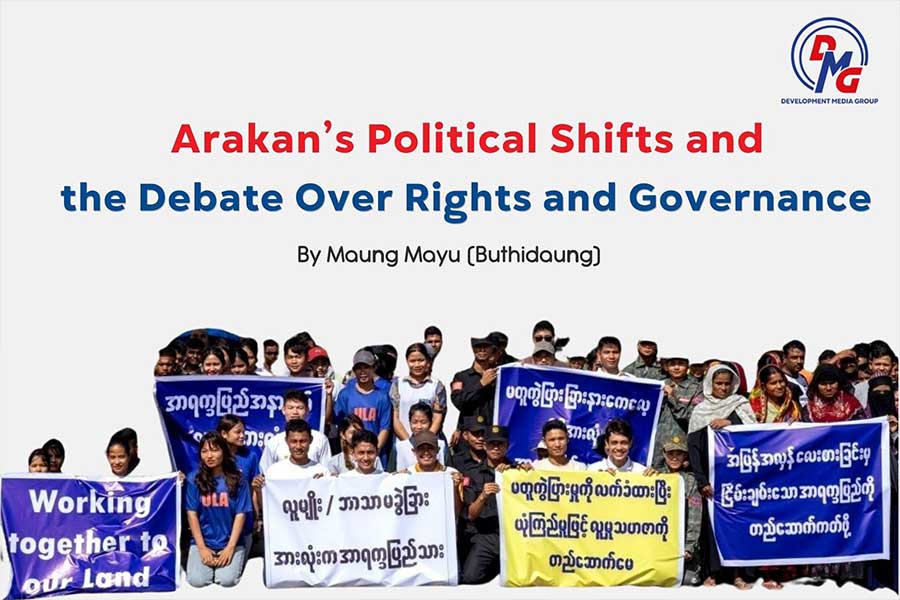
Arakan’s Political Shifts and the Debate Over Rights and Governance
“The Myanmar military created the system that drove the Rohingya from their homeland. The Arakan Army must not be allowed to continue such persecution under a different flag.”
27 Aug 2026
By Maung Mayu (Buthidaung)
“The Myanmar military created the system that drove the Rohingya from their homeland. The Arakan Army must not be allowed to continue such persecution under a different flag.”
This passage appears in the Burmese translation of an article by Muslim writer Misbah Mushorof titled, “Who built this system of death that has seen thousands of Rohingya perish at sea?” The translated article, titled “Who Built the Deadly System That Has Caused Rohingya to Die at Sea?”, was published by Mizzima on July 18, 2026.
The article describes Mushorof as a Muslim who once lived in Myanmar. Following the events of 2017, he became a Cox’s Bazar-based human rights defender and researcher writing about the Muslim crisis, accountability, displacement and human rights issues in Myanmar and the wider region.
What I want to argue here is that Misbah Mushorof appears to be a researcher who does not yet fully understand the current situation in Arakan or the political shifts taking place there. It may not be an exaggeration to say that he has focused primarily on the “Rohingya issue” without making sufficient effort to understand the broader situation.
Why do I say this? Because the Arakan Army is not arbitrarily treating the people of Arakan under the Arakan flag in the same way that the Myanmar military did. Muslims are also among the people of Arakan.
At the beginning of his article, Mushorof explains that the main reasons Muslims have become boat refugees include the denial of citizenship, attacks on villages, restrictions on freedom of movement, and barriers to education, healthcare and employment.
He then writes that a boat carrying around 250 passengers lost contact after leaving Arakan in late June, while another vessel carrying approximately 280 people sank near the Ayeyarwady coast on July 8. He consequently expresses concern that more than 500 Muslims may have died.
The author asks why so many Muslims came to believe that undertaking a highly dangerous sea journey was safer than remaining on land.
Later, however, the article turns its attention primarily toward the Arakan Army (AA). Citing research reports produced from outside Arakan, it claims that AA-controlled areas are subject to severe restrictions on movement, forced labour, arbitrary detention, recruitment, property confiscation, and restrictions affecting agriculture, fishing, healthcare and humanitarian assistance.
Most troublingly, the article argues that the Arakan Army should not follow the path of the Myanmar military and that liberation should not mean freedom for one ethnic community while creating fear for another.
At this point, I would argue that Mushorof, together with some who identify themselves as human rights advocates, needs to examine whether Muslims currently living in Arakan are living in fear or with greater freedom. Conditions in Arakan under the former Myanmar authorities and those under the present Arakan People’s Revolutionary Government (APRG) are fundamentally different.
In Arakan today, people of different ethnic and religious backgrounds are permitted to practise their religions freely. For Muslims, even Maungdaw’s main mosque, which had been closed under the military council, has been reopened. The APRG has also provided meat and financial contributions for Muslim religious festivals, while award ceremonies have been held for outstanding students at Muslim religious schools.
Muslims from western parts of the region who previously had never visited Kyauktaw or Mrauk-U are now travelling there frequently. They are now able to travel to different parts of Arakan with freedoms comparable to those enjoyed by other residents of Arakan.
In healthcare, Muslims are also receiving treatment alongside other communities. Mobile medical teams operated by the APRG have likewise travelled to Muslim villages to provide healthcare services.
Access to education has also been expanded. More recently, discussions have reportedly been held with Muslim religious teachers to encourage Muslim youths to study not only religious literature but also within the Arakan national education system, so that young people do not miss out on broader educational opportunities.
Employment is another area where circumstances have changed. Under successive former military regimes, it was extremely difficult for a Muslim in Arakan to become a government employee. Under the current Arakan administration, Muslims have reportedly been appointed to positions ranging from lower-level staff to township administrative posts.
Is the current deputy administrator of Buthidaung Township not a Muslim? The same can be said of Maungdaw Township. Educated Muslim youths have also been recruited into the Arakan national education system alongside members of other ethnic communities in Arakan.
As for allegations of arbitrary detention, military recruitment and land confiscation, what we are seeing on the ground suggests that some of these claims may result from misunderstandings. Everyone living in Arakan is expected to comply with the rules and laws established by the APRG. Anyone who violates those rules can be detained and questioned, regardless of ethnicity.
Arakan has not yet achieved complete liberation. It remains in a period of struggle to prevent territories already under its control from being lost. Therefore, everyone living in Arakan has a responsibility to defend the region.
Those who fall within the age range designated by the APRG are required to perform military service. However, those who qualify for exemptions under the relevant rules are not required to serve. Military recruitment should therefore be viewed in the context of efforts to secure the future peace and stability of Arakan.
The APRG is also implementing road and bridge projects and new urban development plans in towns and villages under its control. Some land has been acquired for these projects.
The APRG has provided some compensation, although some of those whose land was acquired have remained dissatisfied. Such land acquisition, however, has not specifically targeted Muslim-owned land. When a road is widened, for example, anyone whose property falls within the project area may be required to make way, regardless of ethnicity.
These are realities that Misbah Mushorof, Muslim communities outside Arakan, and researchers who study human rights should make an effort to understand rather than writing about present-day Arakan based on assumptions rooted in conditions that prevailed under the military council.
Mushorof also argues that the APRG bears responsibility for Muslims who have disappeared while attempting sea journeys. At points, his article gives the impression that the APRG is somehow facilitating the departure of Muslims by boat.
Why, then, are Muslims leaving Arakan and attempting dangerous sea crossings?
In examining this question, I have spoken with some Muslims from Maungdaw District. They said the main reasons were a lack of employment opportunities and difficulties making a living. Those with limited financial means cross into Bangladesh, while those who can afford the journey attempt to travel by boat toward Thailand or Malaysia.
They said that if they can obtain shelter in a refugee camp in Bangladesh, they do not have to worry as much about their basic daily needs. They also explained that when one member of a family reaches a country such as Malaysia, the economic circumstances of relatives who remain behind can improve through financial support. These factors, they said, contribute to decisions to undertake dangerous journeys by sea.
At present, the APRG is concerned about the loss of human resources and is taking various measures to discourage people from leaving Arakan. It is also seeking to bring together human resources from different ethnic communities to build a better future for the region. There is therefore no obvious reason why the APRG would facilitate the departure of people from Arakan.
This is something that Mushorof and some who describe themselves as human rights researchers should understand.
They should also recognize that Muslims are not the only people leaving Arakan through unofficial routes. Over successive generations, Arakanese people and members of other communities have also left Arakan through various means because of limited employment opportunities and economic hardship.
Arakan is now attempting to build a system of governance different from that of the past. There may be weaknesses and difficulties during this process, and there may certainly be issues that require criticism and scrutiny. But such criticism should not ignore realities on the ground or begin from predetermined conclusions.
Therefore, when writing about Arakan, researchers should examine more deeply the lived realities of all ethnic communities residing there, including Muslims, before reaching conclusions.
The value of researchers does not lie in confirming what they already believe. It lies in their ability to search for and uncover the truth impartially.
At a time when the APRG is attempting, under difficult circumstances, to bring together different ethnic communities and build the future of Arakan, the people of Arakan including Muslims should also carefully assess writings by some self-described human rights researchers that could undermine communal unity, while peacefully navigating the political changes now unfolding in Arakan.

Opinion
Arakan’s Political Shifts and the Debate Over Rights and Governance
By Admin 27 Aug 2026
Securing Rights for Bangladesh's Indigenous Peoples is Indispensable
By Admin 09 Aug 2026
Reflections on the Arakanese (Rakhine) Language Curriculum
By Admin 14 Jul 2026
Holding On to Arakan
By Admin 26 Jun 2026
The Arakan Shift and the Echoes of the People
By Admin 13 May 2026
POLITICS

BUSINESS
Industry to manufacture finished goods from coconut starting in early 2020
By Aung Kaung Zaw 20 Nov 2019