

- Junta seeks foothold on strategic island in Kaladan River as Arakan Army counterattacks
- Begging nearly doubles amid livelihood crisis in southern Arakan
- Heavy fighting near junta-held Sittwe fuels fear as frontlines approach city
- Displaced civilians struggle to access healthcare after junta airstrike destroys Ponnagyun clinic
- Kyauktaw market closure disrupts trade and drives up prices across Arakan
Begging nearly doubles amid livelihood crisis in southern Arakan
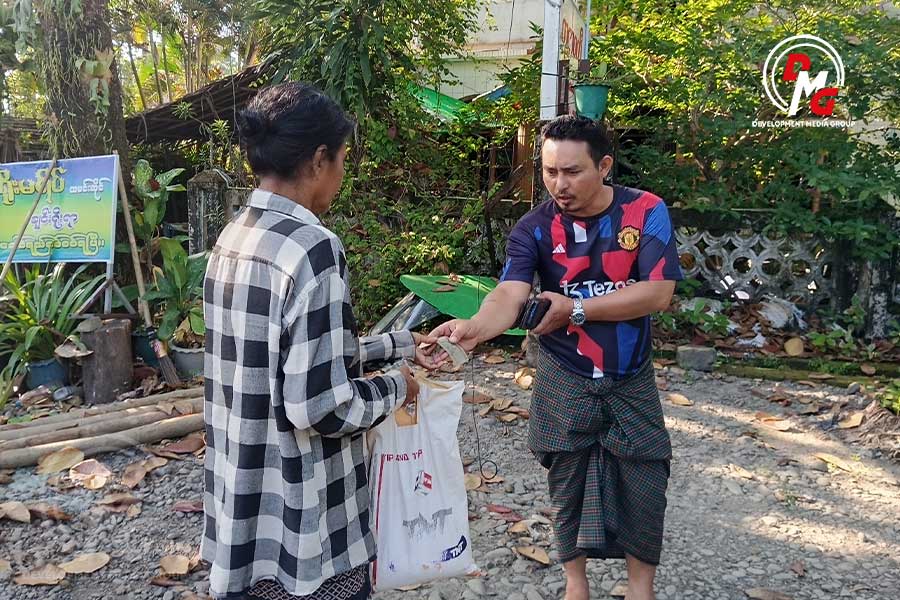
A severe shortage of jobs and soaring commodity prices have deepened livelihood hardships across southern Arakan townships, driving an estimated doubling in the number of people resorting to begging, according to social relief workers and local residents.
12 Oct 2026
DMG Newsroom
12 October 2026, Thandwe
A severe shortage of jobs and soaring commodity prices have deepened livelihood hardships across southern Arakan townships, driving an estimated doubling in the number of people resorting to begging, according to social relief workers and local residents.
In Thandwe Township, where marine fishing is the primary economic driver, the complete shutdown of the fishing industry has created severe livelihood crises for residents who depended on it for their income.
"There are still villages in the Thandwe region where displaced residents are not yet permitted to return to their homes," said a young social aid worker in Thandwe. "Beyond those who relied directly on the marine industry, many locals made a living supporting associated businesses such as prawn depots, fish collection yards, and ice factories. With those operations completely halted, begging has surged out of necessity. Compared with before, we can say it has roughly doubled."
While the United League of Arakan (ULA) and local community organizations provide food assistance across southern Arakan, the scale of need means distributions fall far short of what is required, locals noted.
Residents added that even those attempting to find daily odd jobs to make ends meet face serious dangers from the constant threat of aerial bombardments and junta naval shelling.
Unable to cope with these overlapping crises, more people have turned to begging, with elderly individuals, middle aged women, and young children making up the majority.
"In the past, I used to go down to the creek to work and earn a living," said an elderly woman from Taungup who now relies on alms. "Now, I am unable to work or perform physical labor, so I have to depend on charity. There are three of us, a mother with her children. My husband's health is poor, so he can no longer work as before. Without capital to start a small vending business like others, and with no other employment options, I have to beg to survive."
Widespread unemployment and soaring inflation have turned basic survival into an acute daily challenge, forcing residents to adopt desperate measures.
While some have resorted to begging, others are being forced to sell household furniture and personal belongings piece by piece just to buy food.
"Life is so impossibly difficult that some people have turned to begging for food and relying on alms," a Thandwe resident said. "Some young, able-bodied women have even been driven to exchange sex for survival to feed their families."
Amid ongoing conflict, territorial instability, and a lack of stable employment, more than two thirds of Arakan State's population are experiencing multidimensional poverty, according to an October 8 report by the United Nations Development Programme (UNDP).
The UNDP noted that Arakan residents are trapped in severe poverty driven by widespread insecurity, the loss of regular livelihoods, and crippling economic blockades.

Top News
Begging nearly doubles amid livelihood crisis in southern Arakan
By Admin 12 Oct 2026
Heavy fighting near junta-held Sittwe fuels fear as frontlines approach city
By Admin 12 Oct 2026
Four civilians killed in junta shellings in Ayeyarwady Region
By Admin 11 Oct 2026